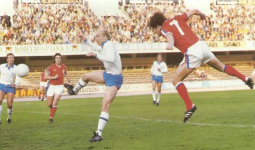
Founded in 1902 as Madrid Foot-ball Club, the Bernabéu is the club’s sixth stadium although the “estadios” used before 1912 were little more than roped-off fields.
The first properly developed ground was the Campo de O’Donnell, which the club used for just over a decade before making the ill-advised move to a newly constructed velodrome in the eastern suburb of Ciudad Lineal.
Away from the centre of town and the nucleus of Real Madrid’s support, the club stayed here for little over a year, before decamping to the district of Chamartin and a specially commissioned 15,000-capacity stadium.
The
Campo de Chamartin remained the club’s home for 22 years, although, following its near-destruction during the Civil War, it was rebuilt and, at its peak, held 22,000.
This was not big enough for the former player, club secretary and now club president Santiago Bernabéu.
In 1944, Bernabéu approved the purchase of 5 hectares of land that was sandwiched between the existing stadium and the Castellana, or Avenida del Generalísimo Franco as it was then known.
On this site, at a staggering cost of 38 million pesetas, Real Madrid would build the new Estadio Chamartin and Bernabéu himself broke the first ground in October 1944.
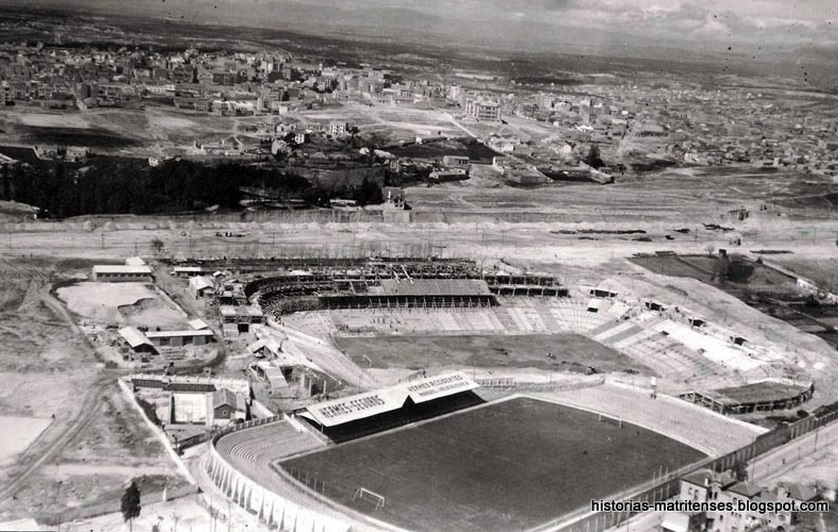
The Old and the New. The Nuevo Chamartin starts to take shape.
The new build was on the old stadium’s doorstep, so close in fact that the northeast corner of the old Chamartin encroached on the new stadium’s footprint.
Work continued on the other three sides, and Real Madrid finished off the 1945-46 season before finally closing the doors of the old Chamartin in May 1946.
The new stadium took a further 18 months to complete, and so Real Madrid took up residence at Atlético Madrid’s
Estadio Metropolitano.
Finally, on 14 December 1947, Real entertained OS Belenenses of Portugal in the inaugural match at the Nuevo Estadio Chamartin.
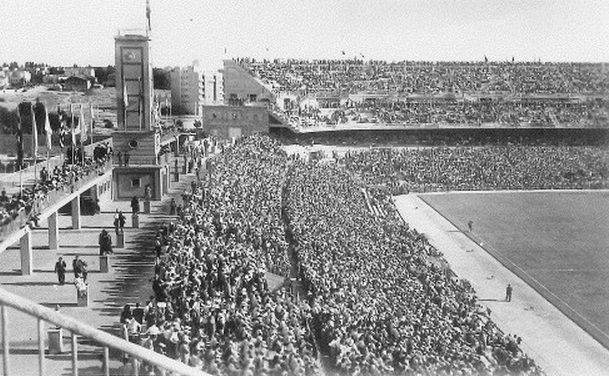
Designed by Luis Alemany Soler and Manuel Muñoz Monasterio, the stadium had a capacity of 80,000. It was spread over three sides of open double-deck stands and a lower bank of the uncovered terrace on the east side, where the old stadium had stood.
In the centre of this terrace at the rear stood a neo-classical tower.
Work in Progress – Waiting for the fourth dimension.
If Real Madrid was looking for an immediate on-field impact at their new stadium, they were to be disappointed.
At the end of the 1947-48 season, the club finished eleventh, its lowest ever final placing. It is worth noting that, until the mid-1950s, the club’s trophy haul was relatively modest.
Their two league titles had both been won more than twenty years earlier, while seven of their nine Copa victories had come before the Spanish Civil War.
Perhaps Bernabéu sensed that the club was on the verge of something extraordinary, for little more than five years after the stadium opened, it entered the next phase of redevelopment.
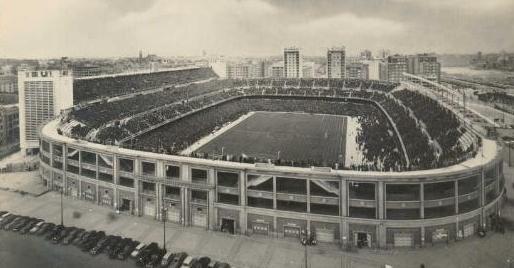
Home of the European champions. Estadio Santiago Bernabéu in 1957.