The next stage saw Brazil in what everyone popularly called “the group of death”, including an out-of-sorts Argentina who were still preoccupied with the Falklands War and the over-expectation around Maradona, who was looking to move to Europe after the World Cup. And then there was Italy, who had laboured, uninspiringly, through their group with draws against Poland, Peru and Cameroon.
Brazil had charmed their way through the competition, along with a French side that had overcome a defeat in their first game and included the gifted Michel Platini. If football was to be the winner, the final should have been between these two countries.
Brazil beat a fractious Argentina 3-1, a game that ended with Maradona receiving a red card for a foolish attack on Batista. Argentina had already been beaten 2-1 by Italy, so they were out and this meant a draw would be enough for Brazil to reach the semi-finals, and they were favourites.
Italy, however, had a secret weapon simmering away in Paolo Rossi, the 25 year-old Juventus striker who had only just returned from a two-year ban due to his involvement in the Totonero betting scandal. Rossi, like Italy, had failed to make an impact in the first group stage. Against Argentina, he was subbed for the second time in the competition with 10 minutes to go. Rossi’s ability prior to his ban was unquestioned, but the decision to take him to Spain was controversial. Against Brazil, he would silence the critics and enjoy his finest hour.
Rossi opened the scoring after five minutes, a header on the run from Cabrini’s cross to the far post. Socrates levelled on 12 minutes after a good interchange with Zico, but Rossi made it 2-1 after 25, capitalising on a defensive error by Cerezo. It took Brazil 43 minutes to equalise, Falcão netting with another outstanding goal. At this point, Brazil were through to the last four, but they continued to spurn pragmatism and go in pursuit of more goals. With 15 minutes to go, Marco Tardelli played the ball into the area and Rossi turned it home to put Italy ahead and complete his hat-trick. Brazil were behind, and on the brink of elimination. They pressed, they twisted and turned, but the Italian defence refused to yield and prevented their key man, Zico from playing his usual game. There was a sense of disbelief that the overwhelming favourites, the team that had restored faith in the Brazilian ethos of beautiful football, had been knocked out.
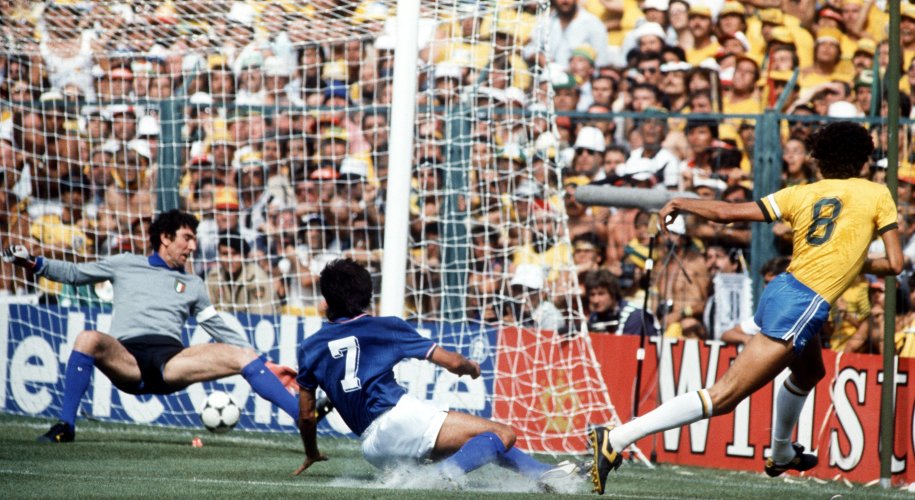
Brazil’s Socrates (r) fires home the equalising goal despite the attempts of Italy’s Gaetan Scirea (c) and goalkeeper Dino Zoff (l)
Death in Barcelona
Italy and Rossi went on to win the competition and Brazil went home, returning as heroes, despite blowing their chance of glory. An embittered Zico, who would also win South American Player of the Year in 1982, commented that “this was the day football died”.
In hindsight, it probably was the end of something special. Brazil’s traditional methods had been beaten by a resilient but unexceptional Italian side. Their last three European competitions had all ended in anti-climax – 1966 in England when Pelé vowed “never again; 1974 in West Germany when the Dutch made it clear, football had moved on; and now in Spain when an inferior team had deprived them of success.
By the time 1986 came around, Brazil still had some of the 82 squad, but they went out of the Mexico-hosted competition in the quarter-finals, and they were, after all, four years older. Desperate to win the World Cup again – each passing competition would provide a reminder, “it’s 20 years since…” – but questioning their own approach, they finally did it in 1994 in the US with a team that had very little in common with the heritage of the nation’s football. And unsatisfyingly, they did it on penalties after a dire game with old foes Italy.
The 1982 team really was the last flickers of the eternal flame that was lit as far back as the 1950s, when artistry and guile were staples of the Brazilian game. We still long to be stimulated by Brazilian skill, but we are ito often let down, even though footballers are made and nurtured in South America’s biggest nation. What is missing today is the spirit that gave us Garrincha, Pelé, Jairzinho, Ronaldo, Romario, Socrates, Falcão, Éder and Zico. Will it ever return?
@GameofthePeople
Brazil had charmed their way through the competition, along with a French side that had overcome a defeat in their first game and included the gifted Michel Platini. If football was to be the winner, the final should have been between these two countries.
Brazil beat a fractious Argentina 3-1, a game that ended with Maradona receiving a red card for a foolish attack on Batista. Argentina had already been beaten 2-1 by Italy, so they were out and this meant a draw would be enough for Brazil to reach the semi-finals, and they were favourites.
Italy, however, had a secret weapon simmering away in Paolo Rossi, the 25 year-old Juventus striker who had only just returned from a two-year ban due to his involvement in the Totonero betting scandal. Rossi, like Italy, had failed to make an impact in the first group stage. Against Argentina, he was subbed for the second time in the competition with 10 minutes to go. Rossi’s ability prior to his ban was unquestioned, but the decision to take him to Spain was controversial. Against Brazil, he would silence the critics and enjoy his finest hour.
Rossi opened the scoring after five minutes, a header on the run from Cabrini’s cross to the far post. Socrates levelled on 12 minutes after a good interchange with Zico, but Rossi made it 2-1 after 25, capitalising on a defensive error by Cerezo. It took Brazil 43 minutes to equalise, Falcão netting with another outstanding goal. At this point, Brazil were through to the last four, but they continued to spurn pragmatism and go in pursuit of more goals. With 15 minutes to go, Marco Tardelli played the ball into the area and Rossi turned it home to put Italy ahead and complete his hat-trick. Brazil were behind, and on the brink of elimination. They pressed, they twisted and turned, but the Italian defence refused to yield and prevented their key man, Zico from playing his usual game. There was a sense of disbelief that the overwhelming favourites, the team that had restored faith in the Brazilian ethos of beautiful football, had been knocked out.

Brazil’s Socrates (r) fires home the equalising goal despite the attempts of Italy’s Gaetan Scirea (c) and goalkeeper Dino Zoff (l)
Death in Barcelona
Italy and Rossi went on to win the competition and Brazil went home, returning as heroes, despite blowing their chance of glory. An embittered Zico, who would also win South American Player of the Year in 1982, commented that “this was the day football died”.
In hindsight, it probably was the end of something special. Brazil’s traditional methods had been beaten by a resilient but unexceptional Italian side. Their last three European competitions had all ended in anti-climax – 1966 in England when Pelé vowed “never again; 1974 in West Germany when the Dutch made it clear, football had moved on; and now in Spain when an inferior team had deprived them of success.
By the time 1986 came around, Brazil still had some of the 82 squad, but they went out of the Mexico-hosted competition in the quarter-finals, and they were, after all, four years older. Desperate to win the World Cup again – each passing competition would provide a reminder, “it’s 20 years since…” – but questioning their own approach, they finally did it in 1994 in the US with a team that had very little in common with the heritage of the nation’s football. And unsatisfyingly, they did it on penalties after a dire game with old foes Italy.
The 1982 team really was the last flickers of the eternal flame that was lit as far back as the 1950s, when artistry and guile were staples of the Brazilian game. We still long to be stimulated by Brazilian skill, but we are ito often let down, even though footballers are made and nurtured in South America’s biggest nation. What is missing today is the spirit that gave us Garrincha, Pelé, Jairzinho, Ronaldo, Romario, Socrates, Falcão, Éder and Zico. Will it ever return?
@GameofthePeople