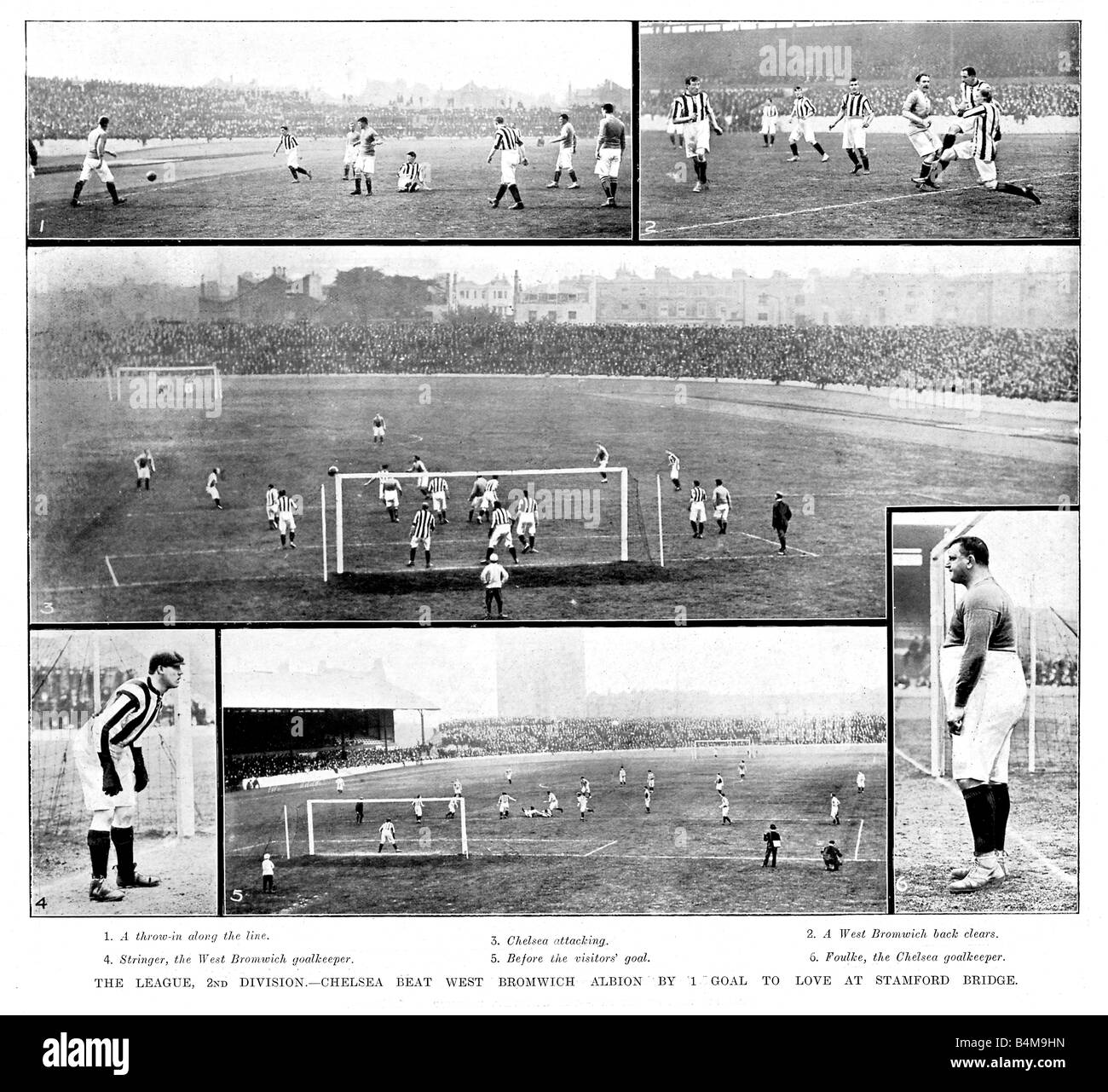
Chelsea v West Brom Sept 1905

erskblue

Legend
Messages
38,723
Reaction score
29,963


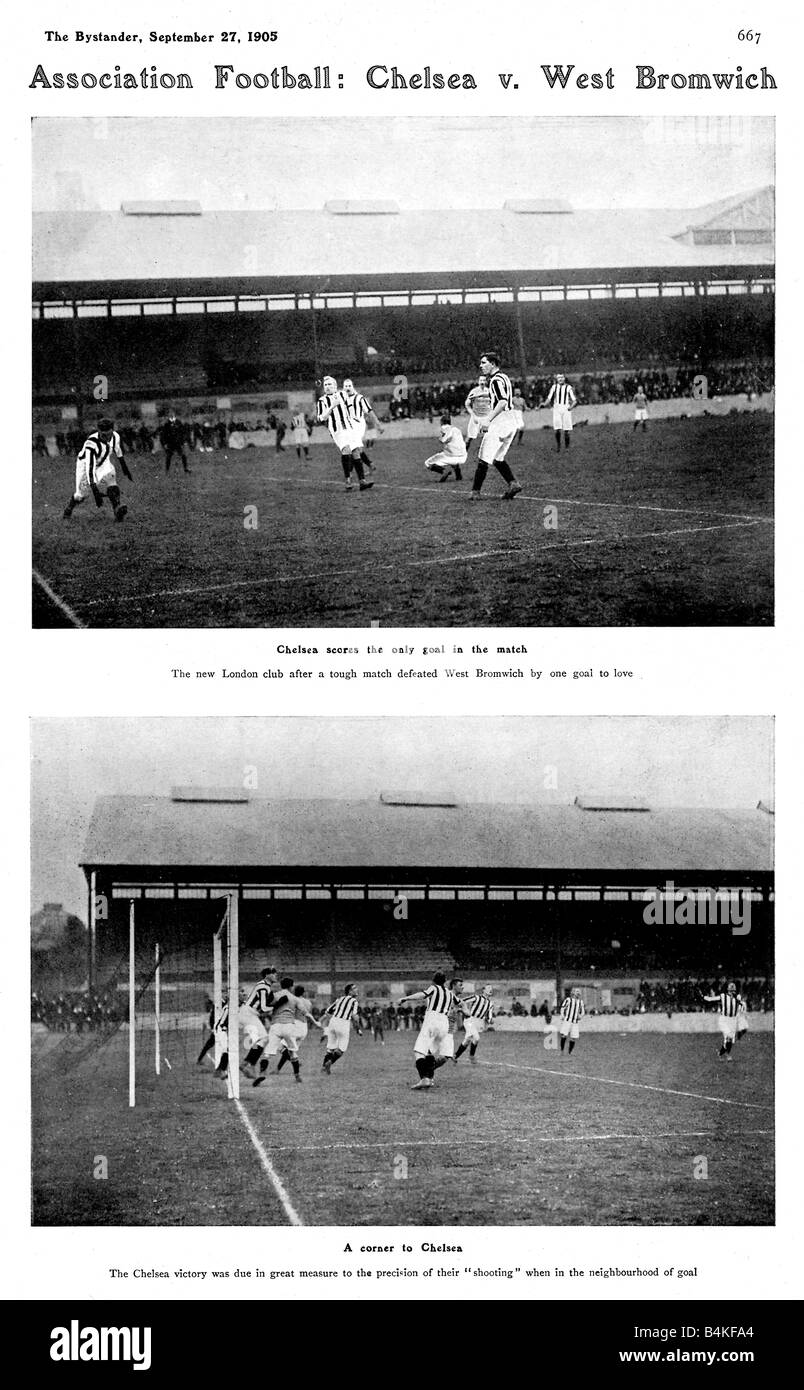
I came across a couple of photos from this game back in Sept 1905.

Now I don't want these pictures to get lost in the overall thread,

So I thought they deserved a thread of their own,

(I admit, I post at times 'random Chelsea vintage pics'. Guilty My Lord ! :biggrin:  )

 
Last edited by a moderator:
Great pictures ,good to see WBA in their traditional kit as well 

 
http://www.bounder.friardale.co.uk/Results/1905.htm#5

Football League Div 2

Game played on Saturday, 23rd September 1905 at 15:15

We won 1-0 with  Bob McRoberts scoring for us in the 25th min.

A crowd of 10,123 saw it.

It was only our second ever competitive match at The Bridge.

That's why I think it is of historic value and deserves a thread of it's own.


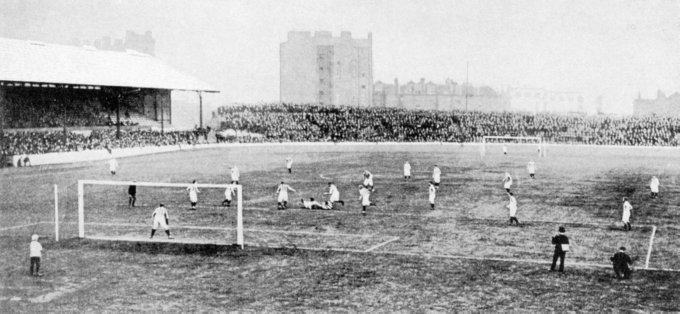
I've had a look and can't find any pictures of us playing before this match !

This picture of The Bridge being completed, has been posted before.

Just thought it was relevant to this thread and so worth posting again.

 
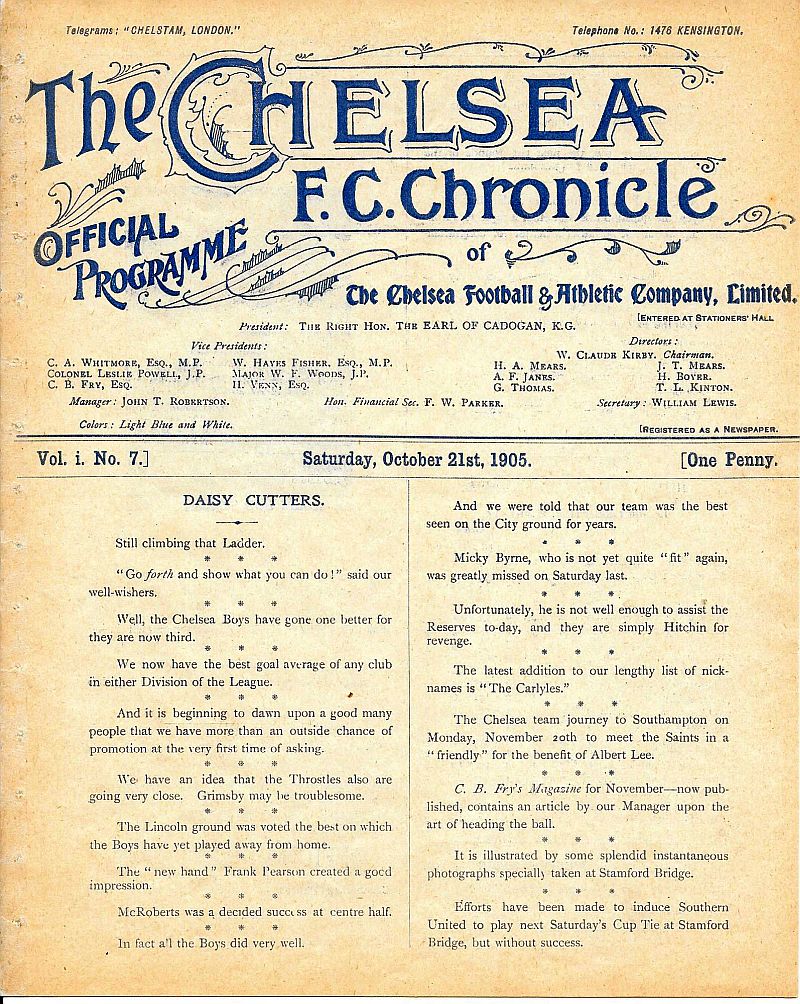
19051021.jpg


http://www.bounder.friardale.co.uk/Programmes/1905-06/HTML/19051021.htm

Just seen this programme cover for our match with Chesterfield at The Bridge on Saturday, 21st October 1905

Thanks again to bounder.friardale. ::clap2::

First programme I can see of us playing at The Bridge on this great historic site.

Thought it worth posting .


I've had a look and can't find any pictures of us playing before this match !

This picture of The Bridge being completed, has been posted before.

Just thought it was relevant to this thread and so worth posting again.
"Chelsea's new ground, built on the site of the old athletic ground at Stamford Bridge, will comfortably accommdate 150,000 spectators".

Never heard of any other British grounds that had such a capacity, Walham Green station must have been a crush!

 
"Chelsea's new ground, built on the site of the old athletic ground at Stamford Bridge, will comfortably accommdate 150,000 spectators".

Never heard of any other British grounds that had such a capacity, Walham Green station must have been a crush!
Hampden is the only other British Ground to have such a 150,000 capacity.

The 1937 Scotland v England match had an official attendance of 149,415, but at least 20,000 more entered the ground without tickets.

Just wonder how many  spectators were actually in The Bridge for the 1945 Dynamo Moscow game.

 
1905-06.jpg


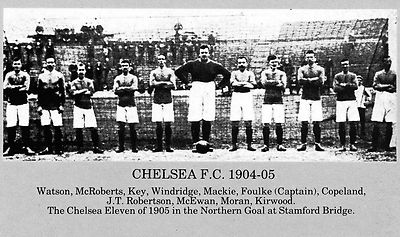
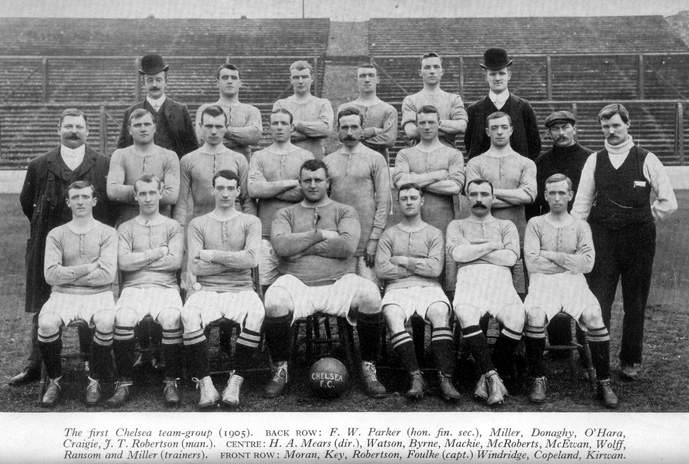
Found a couple of team groups from our first ever season.

First one on left, is a year (1904) early !

 
Found this article. Thought it relevant.

Hope you think its worth me posting on this thread.

https://playupliverpool.com/1905/09/09/the-chelsea-club-1905-06/

The Chelsea club 1905-06

September 9, 1905
The latest recruit to southern football is the Chelsea Club, which opened its gates to the public on Monday evening, September 4. It bids fair to be a power in the football land, for its enclosure, when completed, will be one of the most comfortable and commodious in Great Britain, and the team should prove strong enough to gain a prominent position in the second Division of the League.

Already upwards £30,000 has been spent on the ground, and accommodation is being made for 150,000 spectators. The covered stand is a model structure. Built to hold 6,000 people, it is replete underneath with rooms for the players, officials, and visitors, and the baths provided for the men are in advance of any in the South.

The right sort of sportsmen are connected with its management too, The Earl of Cadogan and Mr. C.B. Fry are the President; and the directorate include Mr. H.A. Mears and Mr. G. Thomas. Mr. Mears owns the ground, and he is practically superintending its making. He is a keen sportsman, and is as well-known in racing circles as in connection with football.

In Mr. Thomas, of Southampton, he has a worthy colleague, for there is no more enthusiastic supporter of the winter pastime than the Sotonian. He is proprietor of the Southampton Club’s ground, accompanies the men to most of the matches, and an international game would not seem itself if he, and Mrs. Thomas, were not among the spectators.

Then there is Mr. Fred W. Parker, as hon. financial secretary. Mr. Parker has been connected with athletics for many years, and is one of our best-known handicappers. He is found of sports in all its forms and occupies the position of secretary of the London Athletic Club.

The players are all good-class men, the older ones having made great reputations on the field, while the younger are full of promise. A few particulars about them may be of interest.

Goal:
Bill Foulke (captain and goalkeeper) comes from Sheffield United. He has kept goal for England. He is the bulkiest football player living, and is such a mountain of flesh between the posts that opposing forwards are said to have complained that they had not sufficient of the goal to shoot at. As a compromise that marks should be drawn on Foulkes. If the ball hit him inside the marks it was a save, but if outside the shot should count as goal.

Mick Byrne (Southampton) is understudy to Foulkes, and is likely to make a great name for himself.

Backs:
Bob Mackie (Heart of Midlothian) is 22 years old, a clever and determined tackler at back, and was one of the fastest men in Scotland last year.

Dougal Watson, jun. (Sunderland), 23 years, is a young player of great promise.

Tommy Miller (Falkirk), 22 years, was looked upon as the Burgess of Scotland. He is little, but strong, and absolutely fairless.

Bob McEwan (Glasgow Rangers), 23 years, has had experience both with Bury and the Rangers. He is a player of the “Donald Gow” type, with plenty of speed and a safe kick.

Half-backs:
George Key (Heart of Midlothian), 24 years, should be one of the “stars” of the team. He is a Scottish international, a safe tackler, and players well to the forwards.

Bobby McRoberts (Small Heath), 29 years, was formerly a centre-forward, but is now playing centre-half, where his speed and judgment should prove of great account.

John T. Robertson (manager), 28 years, comes from Glasgow Rangers, and formerly played for Southampton. He holds seventeen International, and six Inter-League caps; and has captained Scotland both for the Nation and the League. He is a half-back of resource, tireless and determined, and the wing facing him will have to be clever to get the better of the argument. He does not like the sea, and twice refused to play against Ireland as he dreaded the voyage. His friends say that he makes up on land for any fear he may display on the water.

1905-chelsea-robertson.jpg


Forwards:
Marty Moran (Heart of Midlothian), 25 years, is well-known in the South owing to his connection with Millwall. He is tricky, cool, and centres well.

David Copeland (Tottenham Hotspur), 28 years, used to play inside left for the Spurs, but has been transferred to the other wing.

Jimmy Robertson (Small Heath), 22 years, the centre-forward, combines well, is speedy, and a capital shot at goal.

Jimmy Windridge (Small Heath), 22 years, is a coming international. He has speed and cleverness, and shoots well.

1905-chelsea-windridge.jpg


Jack Kirwan (Tottenham Hotspur), 27 years, is the Irish International who did such sterling service for the Spurs.

Charles Donnachie (Glasgow Rangers), 21 years, is built on the small side. He has got command over the ball, and centres beautifully.

Walter Toomer (Southampton), 23 years, is very fast and a good shot.

Reserves.
Half-backs:
Jim Craigie (Manchester City), 21 years, is good enough for any team, and a capital emergency man.

Fred Wolfe (Hull City), 20 years, is likely to turn out well.

Forwards:
Francis O’Hara (Coatbridge), 20 years, controls the ball cleverly, has speed, and puts plenty of power into his shooting.

Altogether the team appears a strong one from the goal to the centre-forward.

1905-chelsea-squad-picture.jpg

(Penny Illustrated Paper: September 9, 1905)

 
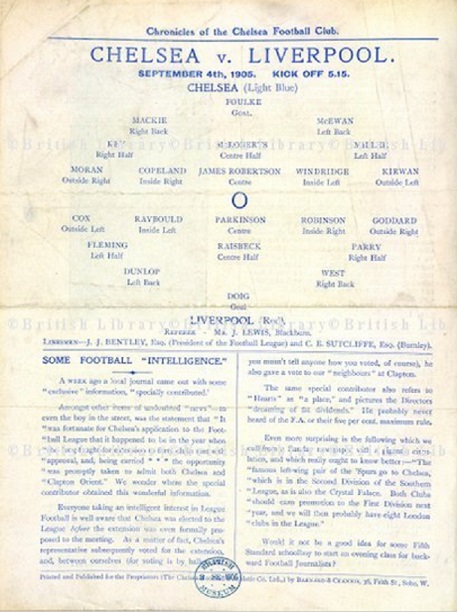
Chelsea v Liverpool 4-0 (Friendly: September 4, 1905


September 4, 1905
Match: Friendly, at Stamford Bridge, kick-off: 17:15.
Chelsea – Liverpool 4-0 (0-0).
Attendance: 10,000.
Referee: Mr. John Lewis (Blackburn); linesmen: Messrs. John James Bentley and Charles Sutcliffe.
Chelsea (2-3-5): Bill Foulke, Bob Mackie, Bob McEwan, George Key, Bobby McRoberts, Tommy Miller, Marty Moran, David Copeland, James Robertson, Jimmy Windridge, Jack Kirwan.
Liverpool (2-3-5): Ned Doig, Alf West, Billy Dunlop; Maurice Parry, Alex Raisbeck, Robert Robinson, Arthur Goddard, George Shalders, Charles McGibbons, Sam Raybould, John Cox.
The goals: 1-0 McRoberts, 2-0 McRoberts, 3-0 Moran, 4-0 Windridge.

Match report:
* Liverpool Daily Post: “Liverpool fall at Stamford Bridge”.


chelsea-1905.jpg


x
Bill Foulke, Chelsea F.C. (Athletic News: November 20, 1905).
1905-bill-foulke-chelsea-e1495889858124.jpg

x
James Robertson, Chelsea F.C. (Athletic News: October 16, 1905).
1905-james-robertson-chelsea-e1495845915557.jpg

x
Bobby McRoberts, Chelsea F.C. (Athletic News: September 18, 1905).
1905-bobby-mcroberts-chelsea-e1495839186576.jpg

 
Match report in the Liverpool Daily Post.

September 5, 1905

Liverpool met Chelsea under somewhat disadvantageous terms at Stamford Bridge, last evening, before 10,000 spectators.

The Notherners played McGibbons in the place of Parkinson, in view of the latter’s regrettable accident on Saturday. Shalders displaced Robinson at inside right, and Fleming (left half) gave way to Robinson. Otherwise it was the same team that lost points to the Woolwich Arsenal. Liverpool won the toss, and played with the sun at their backs. The Liverpool men set the pace, and Chelsea responded with a fast forward movement, Doig having to ward off a couple of hot shots.

Chelsea kept up the pressure, and the Liverpool defence was being hard put to it when Cox raced down the left and centred for Shalders to shoot feebly. Dunlop stopped an ugly move on the part of the Chelsea forwards, and Goddard improved the Liverpool position.

The Chelsea forwards made the running again, and Moran shot wide close up. Chelsea were having all the best of the match. Shalders and Goddard did some nice things, and transferred play to the Chelsea quarters, McGibbons making a weak attempt at goal.

Liverpool taking a serious view of the position, sent Cox down the left, and McGibbons was pulled up for offside right in the goalmouth. Chelsea attacked, and should have scored. McRoberts over-running the ball when close in. When half-time arrived the score had not been opened.

Liverpool took up the running on the resumption. The attack was not of long duration, for the Chelsea front men secured and dribbled the length of the field, a nice-looking maneuver culminating in a goal by McRoberts.

Liverpool gave way after this, and Windridge centred finely for McRoberts to put Chelsea two points ahead. Chelsea were let in again, Moran, taking advantage of a temporary misunderstanding in the Liverpool back line, sending in the third point. Misfortune followed misfortune, and Windridge put Chelsea four on top.

It was a comfortable win for Chelsea. Result: Chelsea 4 goals, Liverpool nil.

Chelsea: Bill Foulke, Bob Mackie, Bob McEwan, George Key, Bobby McRoberts, Tommy Miller, Marty Moran, David Copeland, James Robertson, Jimmy Windridge, Jack Kirwan.
Liverpool: Ned Doig, Alf West, Billy Dunlop, Maurice Parry, Alex Raisbeck, Robert Robinson, Arthur Goddard, George Shalders, Charles McGibbons, Sam Raybould, John Cox.
(Liverpool Daily Post: September 5, 1905)

 
Unique programmes: Chelsea's first home game


Liverpool hold a prominent place in Chelsea's history, being the first team to play them in a match at Stamford Bridge. Chelsea's origins can be traced back to a small West London hotel in late 1904 where H. R. Mears, who had acquired the Stamford Bridge Athletic Grounds, ad the idea of forming a first-class football club to go with the athletics meetings that took place there.

When Mears made his feelings public he found very little support. The ground, close to the city centre, was an already established sporting venue. The terraces were constructed using soil from the Underground Railway and covered accommodation for 5,000 was constructed. The stadium was there, but what was missing was a team. To overcome this problem John Tait Robinson was employed, and he spent £500 in producing the team to go with the ground.

Robinson's most famous signing was Billy 'Fatty' Foulke who cost £50 from Sheffield United in May 1905. Billy Foulke holds a unique place in football folklore, being successful in winning two FA Cup winners medals in 1899 and 1902, a runners up medal in 1901 and he played once for England. He remained at Chelsea for just one season before moving to Bradford City in April 1907. He retired in November 1907 and passed away on 1st May 1916 after contracting pneumonia on Blackpool Sands where he was earning a living by inviting members of the public to score goals against him. He also represented Derbyshire at cricket (Information from, Chelsea: A Complete Record 1905-1991. By Scott Cheshire).

Chelsea-a-Fr2.jpg


Chelsea first applied to join the Southern League, yet were turned down. Next, entry to Division Two of the football League was sought where, to everyone's surprise, they got in. Their first ever match was away to Stockport County on 2nd September 1905, where they lost 1-0. Their first ever match at Stamford Bridge was in a friendly played on Monday 4th September when Liverpool were the visitors. Chelsea produced a four page programme to commemorate this event. The front cover obviously focuses on the birth of Chelsea Football Club. The style of writing used remained in Chelsea's programmes right up to the Second World War, with the use of plays on words and snappy short paragraphs.

The second page contains a pen picture of that days referee, a Mr John Lewis whom Chelsea claimed, "In the whole history of Football there has been no more efficient, popular or respected referee." John Lewis was one of the founders of Blackburn Rovers for whom he played for 25 years previously. He refereed three Cup Finals and retired from officiating in March 1905, but was persuaded to return and officiate Chelsea's opening home game. The second page also contains season ticket price details, the best seats being £1's. Also listed were forthcoming fixtures at Stamford Bridge, both football and athletics, as well as an appeal for advertisers to use Chelsea's programme. The linesmen were also prominent members of the Football League being the president and future president respectively.

Page three contains a photograph and profile of William Foulke, Chelsea's new captain. It tells that he stood at 6ft 3in tall and weighed 22 stone, and in their words he, as fine a specimen of manhood as ever stepped onto the field. In spite of his bulk he possesses all the agility of a cat, combined with the playfulness of a kitten.

The line-ups appeared on the back page. Chelsea ran out 4-0 winners. Liverpool had played in the capital two days previously against Arsenal, losing 3-1. Their next game was at home to Blackburn, which they lost 3-1. This was followed by a 5-0 away defeat by Aston Villa. Not a great start to the season. Yet Liverpool finished the campaign as Football League Champions and were close to the double, losing in the FA Cup semi-finals to Everton.

This programme sold earlier this year at auction for £3,300. A good price for such a historic issue.

For more information on Liverpool programmes and memorabilia please send 2 x first class stamps for the latest bulletin of the Liverpool Programme Collectors Club. This contains many articles on past issues and news on current season programmes. Send to: Keith Stanton, 4 Hillview Gardens, Woolton, Liverpool, L25 7XE (0151 42 86 087)The club has been established for over 17 years and exists to promote the enhancement of the hobby and the sharing of information on Liverpool memorabilia between collectors. 

https://www.lfchistory.net/Articles/Article/464


© Robin Gowers, LFChistory.net


Hope nobody minds me copying and re posting this thread and article.


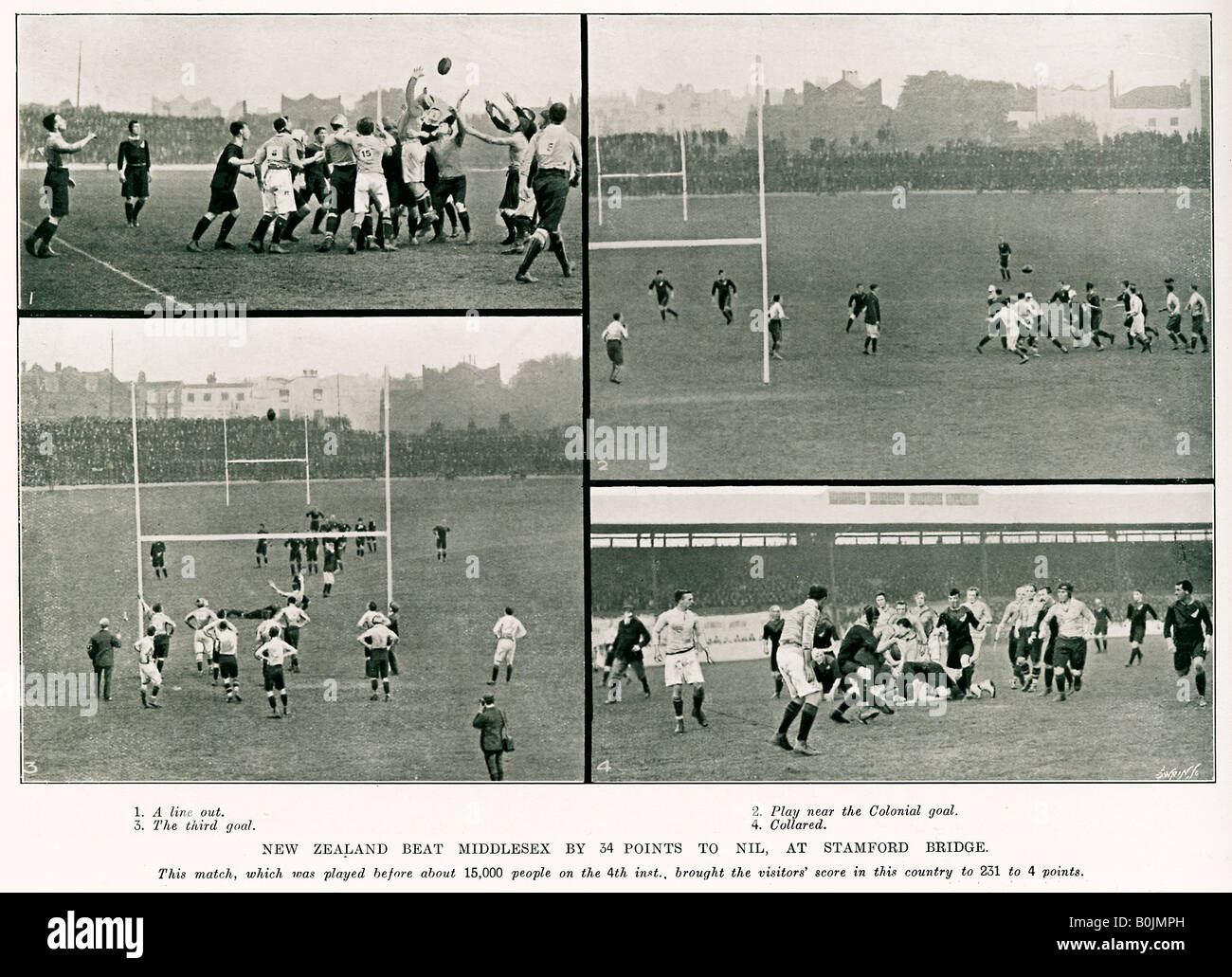
Middlesex v New Zealand 1905 photo spread of the Original All Blacks victory at Stamford Bridge on their inaugural tour

 
Last edited by a moderator:
Back
Top