
You are using an out of date browser. It may not display this or other websites correctly.
You should upgrade or use an alternative browser.
You should upgrade or use an alternative browser.
The Story of the 1915 FA Cup Final
- Thread starter erskblue
- Start date

Twice previous winners and once runners-up, Sheffield United had made it through to their first Cup final since 1902. Either side of the turn of the century United were one of the most dominant forces in English football, taking the Football League Championship in 1897/98 and finishing second in 1899/1900. They also lifted the Cup in 1898/99 and 1901/02 and lost the final in a replay in 1900/01, thus making five consecutive seasons in which the players collected medals. But following the decline or departure of many players the team rarely threatened to challenge for honours for the next decade.
But the arrival of a group of players who were to give United many years’ service heralded a period that the club hoped would bring a repeat of earlier successes. The 1913/14 season at last brought signs of recovery as United reached the semi final, losing out 1-0 to Burnley in a replay at Goodison Park following a goalless draw at Old Trafford, so the club was delighted to go one better the following season.
The commanding George Utley was proving to be the key: he was the captain, left half and the man around whom the team revolved. At last United had found an on-field leader and inspirational figure to replace the great ‘Nudger’ Needham, the ‘Prince of Half Backs’. Utley had played in Barnsley’s Cup win in a replay at Bramall Lane in 1912. The Sheffield United directors liked what they saw and offered his hometown club a British record transfer fee of £2,000 for his services.
Some directors were said to be of the view that no footballer was worth that sort of money (an opinion with which Utley himself agreed) and that he would never last the term of his engagement, but he proved them wrong, despite initially not being keen on the move because he was due a long-service benefit at Barnsley. A five-year contract and the promise of a benefit at the end of it were enough to sway him. United’s run to the 1914 semi final brought in over £13,000 in gate receipts, more than enough to cover Utley’s transfer fee and wages.
It had been known for some time that the traditional venue for the final was unavailable. Other than four replays, every Cup final between 1894/95 and 1913/14 had been staged at London’s Crystal Palace (the site of the current National Sports Centre and athletics stadium), with attendances regularly higher than 70,000 and three times topping 100,000. The 1912/13 final between Aston Villa and Sunderland attracted a massive crowd of 121,919. But the stadium was requisitioned by the Admiralty for military training purposes and closed to the public in February 1915. There was also the potential disruption to travel in the capital for the Football Association to consider in its deliberations over the choice of an alternative venue. The final was therefore moved north for the first time since the early 1890s, to be played on April 24.
Chelsea had had a poor season in the League, finishing in nineteenth place, one point above bottom team Tottenham Hotspur. They did not manage an away League win all season. However, the Cup was a different matter and they pulled off some excellent, and unexpected, results. The Sheffield Daily Telegraph could not see how Chelsea could hope to beat Sheffield United. However, Chelsea were accustomed to being the underdog throughout the later stages of their impressive Cup run. To beat Sheffield United they would have to breach the second-best defence in the League, but in Chelsea’s favour, throughout the season United had found it difficult to score goals. In fact, Chelsea had scored more often, despite being near the bottom of the table.
As the day of the final neared, there was nowhere near the usual excitement and press coverage because of the constant shadow of war that hung over Britain. In fact, one newspaper published a cartoon suggesting that Germany’s Kaiser Wilhelm ought to present the Cup to the winning captain as the continuation of football in England had assisted the war efforts of his country. The cartoon showed the winning captain saying: ‘Thank you, sire.’ The Kaiser responded: ‘On the contrary, thank you.’
The build-up to the final was therefore understandably low key, the war having dampened the usual eager anticipation. The mood of the Sheffield United players was low key too. When asked about the final they did not flicker an eyelid, not from a sense of indifference but one of calm confidence. They were said to be ‘keen as mustard’ and proved it by twice being driven by motor car into Derbyshire before walking back to Bramall Lane. Prior to the final United captain George Utley gave a big hint as to his team’s intended tactics, saying:
If we are foolish enough to make the mistake of trying to play Chelsea at their own game they will beat us. They are cleverer than we are, as far as pretty football is concerned, and if we allowed them to settle down to the Scottish style of attack they adopt we would be laying up trouble for ourselves. The game that we play best is the wide swinging variety, the type that wins Cup ties as a rule, and because that is our natural game, and because it is probably the best paying game in Cup ties we shall play it. There is plenty of room at Old Trafford for anybody, and whatever happens Chelsea won’t be able to say that they haven’t had a “run” for their money.
United’s defence and half backs could always be relied upon, so their prospects largely depended upon the virility of their inconsistent forwards. If they were on song, United would be hard to beat. A Sheffield Daily Telegraph reporter asked various Football Association dignitaries the night before the final whom they thought might win. They were all of the view that it would be Sheffield United. The only person who refused to express an opinion was Mr H. H. Taylor – but he was the referee!
If Chelsea needed encouragement, the match programme noted that the underdog had won six of the last ten finals and that the only previous London club to lift the Cup did so in Lancashire, when Tottenham Hotspur beat the favourites – Sheffield United no less – in a replay at Burnden Park. A full-page article entitled ‘The Last Act’ congratulated the Football Association for selecting the ‘splendidly equipped and commodious’ Old Trafford for the final. The programme was produced by hosts Manchester United FC, with a special version printed on silk for presentation to the players and officials. The front cover encouraged readers to visit Beaty Bros outfitters on Market Street and Oldham Street to purchase ‘New Goods for Spring’ in the shape of suits for 31/6, 42/-, 52/6 or, top of the range, 63/-.
All the Sheffield United players were northern men (but just one from Sheffield), and there were only four from London and its surroundings in Chelsea’s line-up. They too relied heavily on players ‘imported’ from the north, four of them from Scotland. Another highly noteworthy aspect of the game, and probably of football and society of the time, was the heights of the players. None of them were six feet tall and Chelsea’s forward line was particularly small, by today’s standards at least.
Chelsea’s best player, the famous amateur footballer and England international Lieutenant Vivian Woodward, who had missed most of the season on army service, had been given leave to play in the final, withdrawing from the Footballers’ Battalion team that lost 2-1 to the 2nd Sportsmen’s Battalion a couple of days before. However, Woodward sportingly declined his usual inside right position, allowing Bob Thomson, scorer of five goals in the Cup, to keep his place. Thomson had helped the team reach the final, so he should play in it, insisted Woodward.
Both teams adopted the then standard ‘2-3-5’ formation of two backs, three half backs and five forwards. The primary job of the backs was to mark the opponent’s wingers and they scarcely ventured forward. Contemporary newspaper match reports often mentioned that a back had had a good game because he ‘kicked well’, suggesting that when he got the ball he got rid of it quickly and lengthily. Goalkeepers, meanwhile, had to release the ball rapidly once they had caught it, otherwise they would be barged over or have it kicked out of their hands, either event producing a high risk of conceding a goal, and sustaining an injury.
The half backs watched the opposing inside forwards and centre forward, but when in possession of the ball their task was to supply their own forwards. The centre half, in contrast to the role he has today, played a key part in organising his team’s attacks as well as shadowing the other team’s centre forward when they had the ball. The inside forwards often dropped back to collect the ball from the half backs, before then playing it to the winger on their side of the pitch. Each winger’s task was to send in crosses to the centre forward and the onrushing inside forwards. Designed plays from corners and free kicks were rare or non-existent, save for trying a hard shot from a free kick within thirty yards’ range. The five forwards were expected to score the bulk of the goals, and in Sheffield United’s case they certainly did. Of the sixty-one goals the team registered in League and Cup in the 1914/15 season, fifty-six were scored by forwards, just four by half backs and none by backs (one was an own goal).
Chelsea, strongly influenced by the Scotsmen in their team, were known to favour a method of play involving attacks made up of a series of short, pretty, zig-zag passes. This approach was sometimes called ‘drawing room football’ as it could theoretically be played in a confined space. In contrast, Sheffield United’s game was based on hard running and rapid movement of the ball, termed by the Sheffield Independent as a ‘get there quick’ style. They relied on speed and sudden, rapier-like thrusts, rather than the ‘pattern weaving’ preferred by the Londoners. Chelsea were seen as a clever side with little end product, whereas United were a well-drilled team in the true sense of the word, rather than an association of individuals.
There was an eerie atmosphere in Manchester for the final, partially brought about by the general depressing circumstances, but also by the unseasonably dull and drizzly weather, more akin to November than April. The people of Sheffield must have held mixed feelings about the game. Many thought that it should not be played, while one writer in the Sheffield Daily Telegraph claimed that United were ‘bringing shame on themselves and the city’ by participating in such a grand sporting event at this time of death and destruction. Some 49,557 disagreed, parting with gate receipts of £4,012 to back their opinion. Spectators packed on to the large uncovered terraces opposite the grandstand and behind each goal sheltered as well as they could under all manner of hats and umbrellas.
Next part.
Also in attendance were large groups of soldiers in uniform, some on leave, a number sporting bandages protecting injuries suffered at the front. They pulled their hats down low and their greatcoat collars up high to keep out the miserable drizzle. It was the sight of so many uniforms in the crowd that gave rise to the term ‘The Khaki Final’, one of the few Cup finals to be given its own nickname (the Sports Special Green ‘Un of April 24 may have been the first publication to use this term). The Manchester Guardian pointedly commented that those in attendance who were not in uniform should have been. The Sheffield Daily Telegraph correctly predicted: ‘There will, it is safe to say, never again be a Cup final played so long as the country is engaged in such a world war as that which is now in progress.’
Despite the lack of special excursion trains, The Times reported that ‘a good deal of Yorkshire was coming to see the match’. Soon after breakfast all trains from Sheffield to ‘Cottonopolis’ from both the Midland and Victoria Stations were packed, several having to be run in duplicate. It was estimated that three thousand people journeyed over the Pennines by rail. At an early hour, thanks to enterprising Sheffield hotel proprietors and posting houses, hired motor char-a-bancs and other road vehicles began to leave the city en route to Manchester. A steady stream continued west out of Sheffield for some time on a journey that must have taken some three hours on primitive cross-Pennine roads.
Spectators were advised in advance by the Sports Special Green ‘Un of the difficulties of travelling the two-and-a-half miles from Manchester city centre to Old Trafford. Taxi or other independent vehicle was the best option, as trams met a renowned bottleneck some distance away, which was a common cause of complaint amongst local people, although there was an alternative – the Salford line, alighting at Trafford Park, five minutes’ walk away. Once close to Old Trafford most spectators would have to cross a railway bridge of inadequate width, which would cause more trouble after the match than before it as thousands tried to use it at once.
The situation could be improved if the railway companies decided to open the ‘cricket and football station’, a few minutes’ walk from the ground, so people coming from Sheffield would not have to travel into the city centre. As important as travel information was, as the Green ‘Un put it, ‘lining the inner man’ – in other words, where could food outlets be found? Many restaurant keepers closed early on Saturday afternoons so ‘the invaders who do not know the runs are in danger of being left on the wrong side of a meal’. If food could not be found near the ground before kick off, the advice was to make a flying start when the post-match exodus began and make for the centre of the city, where more eating establishments would be open.
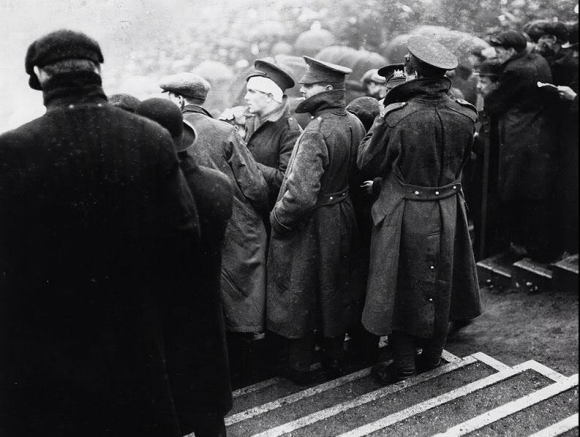 Fed or unfed, those present inside the ground were greeted by a murky day with drizzly fog hanging over the ground, making visibility difficult. It was somehow appropriate that the weather should be so. Some observers doubted that the game would finish in such poor light. One writer described the scene as ‘a Whistlerian monotone in grey’. The drizzle stopped just in time for everyone in the ground to rise and enthusiastically sing ‘God Save the King’ moments before the teams entered the field for the half-past-three kick off.
The Chelsea team arrived first and were ‘cordially cheered, but the roar which saluted them was as nothing compared with that which greeted Sheffield United a moment or so later’, wrote the Sunday Pictorial. United captain Utley, dark haired and of rugged northern appearance, shook hands with his Chelsea counterpart Jack Harrow, also dark haired but of slighter build, and bandaged at the knee, as the match ball sat between them on the oversized centre spot. No pennants or mementoes were exchanged by the two captains.
Beside Utley the referee Mr Taylor stood attentively, his left hand in the pocket of his blazer, his shorts extending down below the knee. He looked no older than the two players. All around them the pitch surface was more rolled mud than grass. The Times, for once reneging on its policy of refusing to include in its pages full match reports, remarked that ‘the preliminaries were more exciting than the game’. The report continued: ‘It must be candidly set down as a poor football match, but it was an interesting spectacle.’ The pitch was tacky but not really wet, so the ball became neither heavy nor slippery, and as there was no wind to blow away the murk, conditions for football were quite favourable.
Chelsea lost Harry Ford to injury in the first few minutes after a collision with Utley; while he was off they won a corner and a couple of free kicks yet when he returned, repaired, it was Sheffield United who took control. Joe Kitchen raced away but Jim Molyneux saved his shot, Jimmy Simmons, Stanley Fazackerley and Kitchen then combined but a dangerous-looking attack was spoiled when Wally Masterman handled. Next, Harrow, standing by the post, kicked away a Kitchen shot with Molyneux beaten, then Masterman shot wide from a good position.
The Sunday Pictorial described the early action: ‘Sheffield United played fast, robust football, keeping the ball always on the move and, as a matter of fact, showing considerably more combination than the Londoners’ front line’. The Sports Special Green ‘Un reporter later wrote; ‘Ten minutes after the start I put down my pencil and remarked to a colleague, “There is no need for excitement over this game. The Cup is won.”’ He was right. A London reporter believed Chelsea were bothered by the weather, writing; ‘They looked up at the thick yellow pall in apprehensive fashion, but the Sheffielders, being quite used to that sort of thing at Bramall Lane, took no notice of it.’ What nonsense, replied the Green ‘Un; southerners apparently believed two things regarding the weather – that the sun never set on the British Empire, and it never shone on Sheffield.
The poor weather had little to do with United’s dominance, but it was surprising that it took thirty-six minutes to score the first goal. The United half-back line of Albert Sturgess, Bill Brelsford and Utley was in total control and the forwards were quickly switching the ball from wing to wing. Such a move produced the first goal, scored by Jimmy Simmons. Harrow was forced to pass back to Molyneux in order to break up an attack, the goalkeeper hurriedly kicking the ball out of play. From the throw-in:
The ball was lifted high over the centre by Utley. Bouncing behind Harrow, who vainly tried to head away, it went to Simmons, who from an oblique angle put in a swift, rising shot, the ball striking the far post and rebounding into the back of the net.
After the goal Molyneux and Harrow were seen to argue. It seemed that Harrow expected Molyneux to come out and catch the ball, whereas the goalkeeper expected Harrow to head it away. Chelsea had their best chances just before half time when shots from Harold Halse and Tommy Logan were saved by Harold Gough and Ford struck one wide. So it was 1-0 at the interval, during which the band marched and played ‘Tipperary’, the song adopted and sung by the British troops as they marched off to war. There was also a collection on behalf of the East Lancashire branch of the British Red Cross Society, undertaken by soldiers, many of whom were Boer War veterans wearing South African army colours, including one who had lost an arm. They held up khaki-coloured sheets into which spectators threw pennies, ‘something after the manner of firemen catching one who leaps from a window’, reckoned The Times.
As the second half began the fog became thicker and more yellow, preventing a good view of the pitch from the stands and terraces. The Times commented that ‘this was no great loss for it was not much worth seeing’. Referee Mr Taylor now seemed to be the most active person on the field, rushing to keep up with play just so he could see what was going on. For a spell the play of both sides was poor, Chelsea’s especially so. Their forwards’ passing was awry and they were often easily robbed of possession by United’s halves. Molyneux made a number of good saves and Masterman had the ball in the net but was given offside. It was becoming clear that United had the measure of their opponents and should win, unless there was an unforeseen disaster. The Chelsea forwards were so much in the pocket of Utley that Halse and Bob Thomson swapped positions to try to escape the United captain’s attentions, but to no avail. The fog cleared somewhat towards the end of the match but the light was fading on a dull day as United finally got the second goal their dominance deserved:
Seven minutes from the finish came a slashing attack, started on the left by Utley. It resulted in a stinging shot being sent in. The ball struck the cross-bar, but, as it rebounded, Fazackerley dashed in, and headed it into the net clear of Molyneux.
If there was any doubt as to the outcome, this goal ended it. A minute from the end Kitchen sealed a 3-0 victory with a great goal.
Gaining possession near the half way line and in making a straight dash for goal, he kept Bettridge off, drew Molyneux out of his fortress and placed the ball in the net after a dribble of forty yards at the least.
Some of the crowd promptly came on to the pitch, thinking the game was over. ‘A number of over-excited youths and men rushed on to the ground, wrung the hands of Kitchen and Utley in fine frenzy, and looked as though they meant to stay there,’ reported the Sheffield Daily Telegraph. They were followed on to the pitch by others from the terraced side of the ground but the referee reacted by getting the game going again as quickly as possible, with ‘the irrepressibles meanwhile dodging the players in a rush for the edges of the field’. The game concluded with spectators crowding the touchlines.
Apart from Chelsea’s short spells of ascendancy in the first few minutes and after United’s first goal, it had been a one-sided match. United appeared to possess superior pace and fitness throughout and only a good performance from Molyneux in the Chelsea goal prevented the scoreline becoming even more decisive. Chelsea’s forwards were poor, playing ‘without any conception of combination work’. One writer remarked: ‘It was not their [Chelsea’s] day at any time,’ whilst the Chelsea captain Jack Harrow commented: ‘We lost to the better team on the day. They gave us no rest and little chance.’
George Utley’s view was concise and precise: ‘There was only one ball, and we had it most of the time.’ Referee Mr Taylor, who diplomatically made no comment before the match, admitted now that ‘I think the better team won’. The Athletic News reported that ‘United simply brushed Chelsea aside as if they were novices’, and the Sports Special Green ‘Un wrote: ‘If United had won by five goals, they would not have been flattered.’ The Times agreed with the general sentiment of these reports, stating that United’s two late goals gave them a lead ‘more commensurate with their merits’.
Various southern newspapers were grudging in their praise of Sheffield United, but the Sheffield Daily Telegraph declared their opinions worthless anyway, considering they had chosen to neglect the existence of professional football for most of the season. This was the first match on which many of them had reported for several months; they were mocked for showing total disregard for their avowed policy of ignoring football when the Cup final, involving a London team, arrived. ‘We are asked by some of these newly-born critics to imagine that it was a poor final,’ wrote the Telegraph. ‘Well, we have seen well on for a score of such now, and fail to remember one which produced more honest and clean play, or cleverer football. If it be a crime for United to squelch the fritter and glitter of the Chelsea men, then United were criminals of the deepest dye, and if the southerners are to be commiserated with upon having their preconceived plans dashed to nothingness, then they have all our sympathy.’
If some believed that the game did not approach the level of a Crystal Palace final, they were accused of viewing proceedings ‘through London-smoked glasses’. The Telegraph also delighted in the fact that the Cup was won by an all-English team, not one populated by Scots, and speculated that United could be the first club to hold the Cup for two years, as there was likely to be no football in 1915/16. The newspaper was wrong: it turned out to be five years.
It had been a well deserved but, despite the Telegraph’s words, hardly a glorious victory, one based on the commanding play of United’s half backs, particularly captain Utley, whose influence was incalculable. Indeed, he was praised for his ‘omniscience’. He controlled Chelsea’s right wing, where Ford, after his early injury inflicted by Utley, was ‘fairly mesmerised’ by United’s captain, and inside right Halse fared no better. Centre forward Thomson, who seemed to be constantly wary of his elbow injury, found Brelsford ‘insuperable’ and Sturgess made Croal and McNeil on Chelsea’s left look ordinary. This was sweet revenge for Sturgess, who had been given the runaround by Croal in an England v Scotland international a year earlier. To the rear of this solid trio was another line of stalwarts, formed of only two men – Bill Cook and Jack English – who were ‘lightweights in poundage but giants in effectiveness’.
Behind them, wrote the Sheffield Independent: ‘Gough in goal was – Gough. One of his clearances meant the laying out of a couple of his own men. He did the double trick. It was to Gough, “the only way.” He who hesitates is lost. Gough did not hesitate.’ United’s forwards were generally ‘enterprising and speedy’, the best of them being Simmons, whose ‘dazzling runs delighted the crowd’, Fazackerley, who passed well and unselfishly, and Kitchen, who swung the ball out to his wings with certainty and accuracy and was always on the spot when a chance presented itself. The sole topic of argument amongst commentators was whether Utley or Simmons was United’s star man; most agreed it was Utley. There had also been little or nothing in the way of ill-temper in the match, the only heated moment coming when a Chelsea player ‘took a mean and cruel advantage of his opponent, and a “bunch of fives” was threateningly uplifted in response’. A sharp word from the referee quickly calmed the players down. The players involved were unidentified in reports, but the most likely Sheffield United candidate was Bill Brelsford, given his reputation of being one not to back away from confrontation.
The Cup was presented to Utley by Lord Derby, whose speech was difficult to hear as he attempted to address the players over the noisy crowd. His words have been variously (if similarly) reported, but all versions agree that the tone of his speech suggested that the time for games was over; now everyone should concentrate their efforts on fighting for the safety and security of Britain and its Empire. He was sure his appeal would not be in vain; every man must face his duty and do his best.
Sheffield United had won the Cup for the third time in their history, but it was no time to celebrate. It was a hollow triumph. The accepted custom of filling the Cup with beer or champagne and sharing it around the players was not followed by the United team. Instead, a muted meal was taken by directors, players and friends that evening at the Exchange Restaurant in Manchester, where the Cup, draped in red and white, enjoyed a prominent place on the top table. Chairman Tom Bott congratulated the team on their victory and their general conduct. They were gentlemen on and off the field, he declared. Football Association president Charles Clegg – a Sheffield man – also spoke, thanking the players for the good, clean game they had played. It was a pleasure to be associated with them, he said, wishing every one of them prosperity during the trying times ahead. In response to the critics he stated:
There has been some talk of disgrace being attached to winning the Cup this year, but I do not hold with that opinion. I take the victory to be an honour to Sheffield. So far as I am concerned, I take the responsibility for the statement that the action which the Football Association took at the outset would be repeated were the same crisis to arise again. We have suffered more than usual from ill-judged criticism, and people who criticise sometimes get their popularity in proportion to their ignorance, but I think, after all, we acted wisely – having regard to our knowledge of all the circumstances – when we had to come to a decision. That, at all events, was the opinion of the Sheffield United Club, and we did not trouble about the opinion of the critics. I am as proud as anyone that we have won the Cup. It is sheer twaddle talking about disgrace. The disgrace lay with those who made such a suggestion, and not with the players or the club.
Whether honour or disgrace was the correct description, there would be no celebratory dinner or triumphal carriage ride around the city. Understandably and correctly, nobody was in the mood for jubilation over the Cup final result, not even United followers in Sheffield who believed it was right to play the match. Some 1,500 to 2,000 supporters gathered outside the Midland Station to welcome the victorious team back to the city when their train arrived at 10.15pm, despite there being no announcement of its time of arrival. Around forty police constables were on view, but not the Cup, which was taken away almost in secrecy. The players were hurried into taxis and sent home, ‘to the accompaniment of considerable enthusiasm’.
Also in attendance were large groups of soldiers in uniform, some on leave, a number sporting bandages protecting injuries suffered at the front. They pulled their hats down low and their greatcoat collars up high to keep out the miserable drizzle. It was the sight of so many uniforms in the crowd that gave rise to the term ‘The Khaki Final’, one of the few Cup finals to be given its own nickname (the Sports Special Green ‘Un of April 24 may have been the first publication to use this term). The Manchester Guardian pointedly commented that those in attendance who were not in uniform should have been. The Sheffield Daily Telegraph correctly predicted: ‘There will, it is safe to say, never again be a Cup final played so long as the country is engaged in such a world war as that which is now in progress.’
Despite the lack of special excursion trains, The Times reported that ‘a good deal of Yorkshire was coming to see the match’. Soon after breakfast all trains from Sheffield to ‘Cottonopolis’ from both the Midland and Victoria Stations were packed, several having to be run in duplicate. It was estimated that three thousand people journeyed over the Pennines by rail. At an early hour, thanks to enterprising Sheffield hotel proprietors and posting houses, hired motor char-a-bancs and other road vehicles began to leave the city en route to Manchester. A steady stream continued west out of Sheffield for some time on a journey that must have taken some three hours on primitive cross-Pennine roads.
Spectators were advised in advance by the Sports Special Green ‘Un of the difficulties of travelling the two-and-a-half miles from Manchester city centre to Old Trafford. Taxi or other independent vehicle was the best option, as trams met a renowned bottleneck some distance away, which was a common cause of complaint amongst local people, although there was an alternative – the Salford line, alighting at Trafford Park, five minutes’ walk away. Once close to Old Trafford most spectators would have to cross a railway bridge of inadequate width, which would cause more trouble after the match than before it as thousands tried to use it at once.
The situation could be improved if the railway companies decided to open the ‘cricket and football station’, a few minutes’ walk from the ground, so people coming from Sheffield would not have to travel into the city centre. As important as travel information was, as the Green ‘Un put it, ‘lining the inner man’ – in other words, where could food outlets be found? Many restaurant keepers closed early on Saturday afternoons so ‘the invaders who do not know the runs are in danger of being left on the wrong side of a meal’. If food could not be found near the ground before kick off, the advice was to make a flying start when the post-match exodus began and make for the centre of the city, where more eating establishments would be open.
The Chelsea team arrived first and were ‘cordially cheered, but the roar which saluted them was as nothing compared with that which greeted Sheffield United a moment or so later’, wrote the Sunday Pictorial. United captain Utley, dark haired and of rugged northern appearance, shook hands with his Chelsea counterpart Jack Harrow, also dark haired but of slighter build, and bandaged at the knee, as the match ball sat between them on the oversized centre spot. No pennants or mementoes were exchanged by the two captains.
Beside Utley the referee Mr Taylor stood attentively, his left hand in the pocket of his blazer, his shorts extending down below the knee. He looked no older than the two players. All around them the pitch surface was more rolled mud than grass. The Times, for once reneging on its policy of refusing to include in its pages full match reports, remarked that ‘the preliminaries were more exciting than the game’. The report continued: ‘It must be candidly set down as a poor football match, but it was an interesting spectacle.’ The pitch was tacky but not really wet, so the ball became neither heavy nor slippery, and as there was no wind to blow away the murk, conditions for football were quite favourable.
Chelsea lost Harry Ford to injury in the first few minutes after a collision with Utley; while he was off they won a corner and a couple of free kicks yet when he returned, repaired, it was Sheffield United who took control. Joe Kitchen raced away but Jim Molyneux saved his shot, Jimmy Simmons, Stanley Fazackerley and Kitchen then combined but a dangerous-looking attack was spoiled when Wally Masterman handled. Next, Harrow, standing by the post, kicked away a Kitchen shot with Molyneux beaten, then Masterman shot wide from a good position.
The Sunday Pictorial described the early action: ‘Sheffield United played fast, robust football, keeping the ball always on the move and, as a matter of fact, showing considerably more combination than the Londoners’ front line’. The Sports Special Green ‘Un reporter later wrote; ‘Ten minutes after the start I put down my pencil and remarked to a colleague, “There is no need for excitement over this game. The Cup is won.”’ He was right. A London reporter believed Chelsea were bothered by the weather, writing; ‘They looked up at the thick yellow pall in apprehensive fashion, but the Sheffielders, being quite used to that sort of thing at Bramall Lane, took no notice of it.’ What nonsense, replied the Green ‘Un; southerners apparently believed two things regarding the weather – that the sun never set on the British Empire, and it never shone on Sheffield.
The poor weather had little to do with United’s dominance, but it was surprising that it took thirty-six minutes to score the first goal. The United half-back line of Albert Sturgess, Bill Brelsford and Utley was in total control and the forwards were quickly switching the ball from wing to wing. Such a move produced the first goal, scored by Jimmy Simmons. Harrow was forced to pass back to Molyneux in order to break up an attack, the goalkeeper hurriedly kicking the ball out of play. From the throw-in:
The ball was lifted high over the centre by Utley. Bouncing behind Harrow, who vainly tried to head away, it went to Simmons, who from an oblique angle put in a swift, rising shot, the ball striking the far post and rebounding into the back of the net.
After the goal Molyneux and Harrow were seen to argue. It seemed that Harrow expected Molyneux to come out and catch the ball, whereas the goalkeeper expected Harrow to head it away. Chelsea had their best chances just before half time when shots from Harold Halse and Tommy Logan were saved by Harold Gough and Ford struck one wide. So it was 1-0 at the interval, during which the band marched and played ‘Tipperary’, the song adopted and sung by the British troops as they marched off to war. There was also a collection on behalf of the East Lancashire branch of the British Red Cross Society, undertaken by soldiers, many of whom were Boer War veterans wearing South African army colours, including one who had lost an arm. They held up khaki-coloured sheets into which spectators threw pennies, ‘something after the manner of firemen catching one who leaps from a window’, reckoned The Times.
As the second half began the fog became thicker and more yellow, preventing a good view of the pitch from the stands and terraces. The Times commented that ‘this was no great loss for it was not much worth seeing’. Referee Mr Taylor now seemed to be the most active person on the field, rushing to keep up with play just so he could see what was going on. For a spell the play of both sides was poor, Chelsea’s especially so. Their forwards’ passing was awry and they were often easily robbed of possession by United’s halves. Molyneux made a number of good saves and Masterman had the ball in the net but was given offside. It was becoming clear that United had the measure of their opponents and should win, unless there was an unforeseen disaster. The Chelsea forwards were so much in the pocket of Utley that Halse and Bob Thomson swapped positions to try to escape the United captain’s attentions, but to no avail. The fog cleared somewhat towards the end of the match but the light was fading on a dull day as United finally got the second goal their dominance deserved:
Seven minutes from the finish came a slashing attack, started on the left by Utley. It resulted in a stinging shot being sent in. The ball struck the cross-bar, but, as it rebounded, Fazackerley dashed in, and headed it into the net clear of Molyneux.
If there was any doubt as to the outcome, this goal ended it. A minute from the end Kitchen sealed a 3-0 victory with a great goal.
Gaining possession near the half way line and in making a straight dash for goal, he kept Bettridge off, drew Molyneux out of his fortress and placed the ball in the net after a dribble of forty yards at the least.
Some of the crowd promptly came on to the pitch, thinking the game was over. ‘A number of over-excited youths and men rushed on to the ground, wrung the hands of Kitchen and Utley in fine frenzy, and looked as though they meant to stay there,’ reported the Sheffield Daily Telegraph. They were followed on to the pitch by others from the terraced side of the ground but the referee reacted by getting the game going again as quickly as possible, with ‘the irrepressibles meanwhile dodging the players in a rush for the edges of the field’. The game concluded with spectators crowding the touchlines.
Apart from Chelsea’s short spells of ascendancy in the first few minutes and after United’s first goal, it had been a one-sided match. United appeared to possess superior pace and fitness throughout and only a good performance from Molyneux in the Chelsea goal prevented the scoreline becoming even more decisive. Chelsea’s forwards were poor, playing ‘without any conception of combination work’. One writer remarked: ‘It was not their [Chelsea’s] day at any time,’ whilst the Chelsea captain Jack Harrow commented: ‘We lost to the better team on the day. They gave us no rest and little chance.’
George Utley’s view was concise and precise: ‘There was only one ball, and we had it most of the time.’ Referee Mr Taylor, who diplomatically made no comment before the match, admitted now that ‘I think the better team won’. The Athletic News reported that ‘United simply brushed Chelsea aside as if they were novices’, and the Sports Special Green ‘Un wrote: ‘If United had won by five goals, they would not have been flattered.’ The Times agreed with the general sentiment of these reports, stating that United’s two late goals gave them a lead ‘more commensurate with their merits’.
Various southern newspapers were grudging in their praise of Sheffield United, but the Sheffield Daily Telegraph declared their opinions worthless anyway, considering they had chosen to neglect the existence of professional football for most of the season. This was the first match on which many of them had reported for several months; they were mocked for showing total disregard for their avowed policy of ignoring football when the Cup final, involving a London team, arrived. ‘We are asked by some of these newly-born critics to imagine that it was a poor final,’ wrote the Telegraph. ‘Well, we have seen well on for a score of such now, and fail to remember one which produced more honest and clean play, or cleverer football. If it be a crime for United to squelch the fritter and glitter of the Chelsea men, then United were criminals of the deepest dye, and if the southerners are to be commiserated with upon having their preconceived plans dashed to nothingness, then they have all our sympathy.’
If some believed that the game did not approach the level of a Crystal Palace final, they were accused of viewing proceedings ‘through London-smoked glasses’. The Telegraph also delighted in the fact that the Cup was won by an all-English team, not one populated by Scots, and speculated that United could be the first club to hold the Cup for two years, as there was likely to be no football in 1915/16. The newspaper was wrong: it turned out to be five years.
It had been a well deserved but, despite the Telegraph’s words, hardly a glorious victory, one based on the commanding play of United’s half backs, particularly captain Utley, whose influence was incalculable. Indeed, he was praised for his ‘omniscience’. He controlled Chelsea’s right wing, where Ford, after his early injury inflicted by Utley, was ‘fairly mesmerised’ by United’s captain, and inside right Halse fared no better. Centre forward Thomson, who seemed to be constantly wary of his elbow injury, found Brelsford ‘insuperable’ and Sturgess made Croal and McNeil on Chelsea’s left look ordinary. This was sweet revenge for Sturgess, who had been given the runaround by Croal in an England v Scotland international a year earlier. To the rear of this solid trio was another line of stalwarts, formed of only two men – Bill Cook and Jack English – who were ‘lightweights in poundage but giants in effectiveness’.
Behind them, wrote the Sheffield Independent: ‘Gough in goal was – Gough. One of his clearances meant the laying out of a couple of his own men. He did the double trick. It was to Gough, “the only way.” He who hesitates is lost. Gough did not hesitate.’ United’s forwards were generally ‘enterprising and speedy’, the best of them being Simmons, whose ‘dazzling runs delighted the crowd’, Fazackerley, who passed well and unselfishly, and Kitchen, who swung the ball out to his wings with certainty and accuracy and was always on the spot when a chance presented itself. The sole topic of argument amongst commentators was whether Utley or Simmons was United’s star man; most agreed it was Utley. There had also been little or nothing in the way of ill-temper in the match, the only heated moment coming when a Chelsea player ‘took a mean and cruel advantage of his opponent, and a “bunch of fives” was threateningly uplifted in response’. A sharp word from the referee quickly calmed the players down. The players involved were unidentified in reports, but the most likely Sheffield United candidate was Bill Brelsford, given his reputation of being one not to back away from confrontation.
The Cup was presented to Utley by Lord Derby, whose speech was difficult to hear as he attempted to address the players over the noisy crowd. His words have been variously (if similarly) reported, but all versions agree that the tone of his speech suggested that the time for games was over; now everyone should concentrate their efforts on fighting for the safety and security of Britain and its Empire. He was sure his appeal would not be in vain; every man must face his duty and do his best.
Sheffield United had won the Cup for the third time in their history, but it was no time to celebrate. It was a hollow triumph. The accepted custom of filling the Cup with beer or champagne and sharing it around the players was not followed by the United team. Instead, a muted meal was taken by directors, players and friends that evening at the Exchange Restaurant in Manchester, where the Cup, draped in red and white, enjoyed a prominent place on the top table. Chairman Tom Bott congratulated the team on their victory and their general conduct. They were gentlemen on and off the field, he declared. Football Association president Charles Clegg – a Sheffield man – also spoke, thanking the players for the good, clean game they had played. It was a pleasure to be associated with them, he said, wishing every one of them prosperity during the trying times ahead. In response to the critics he stated:
There has been some talk of disgrace being attached to winning the Cup this year, but I do not hold with that opinion. I take the victory to be an honour to Sheffield. So far as I am concerned, I take the responsibility for the statement that the action which the Football Association took at the outset would be repeated were the same crisis to arise again. We have suffered more than usual from ill-judged criticism, and people who criticise sometimes get their popularity in proportion to their ignorance, but I think, after all, we acted wisely – having regard to our knowledge of all the circumstances – when we had to come to a decision. That, at all events, was the opinion of the Sheffield United Club, and we did not trouble about the opinion of the critics. I am as proud as anyone that we have won the Cup. It is sheer twaddle talking about disgrace. The disgrace lay with those who made such a suggestion, and not with the players or the club.
Whether honour or disgrace was the correct description, there would be no celebratory dinner or triumphal carriage ride around the city. Understandably and correctly, nobody was in the mood for jubilation over the Cup final result, not even United followers in Sheffield who believed it was right to play the match. Some 1,500 to 2,000 supporters gathered outside the Midland Station to welcome the victorious team back to the city when their train arrived at 10.15pm, despite there being no announcement of its time of arrival. Around forty police constables were on view, but not the Cup, which was taken away almost in secrecy. The players were hurried into taxis and sent home, ‘to the accompaniment of considerable enthusiasm’.
In the days after the final, criticism that the match had been played at such a time was still pronounced. Opinion was certainly divided. The Sheffield Independent backed the club, stating that the match and the scene had ‘nothing but the best British gold about it’. Football people were supportive, congratulating United on their success. Defeated Chelsea chairman William Claude Kirby sportingly wrote: ‘Kindly convey to your directors, officials and players the hearty congratulations of my co-directors and myself on your club’s victory in the FA Cup last Saturday.’ The Wednesday directors hid their envy well, writing: ‘The directors of the Wednesday Football Club desire to congratulate the directors and players of the Sheffield United Football Club on their success in again winning the Football Association Challenge Cup, and in once more bringing home the trophy to the original home of Association football.’ Notably, several ‘well done’ postcards were received from soldiers at the front.
Whether it was right or wrong to play the final was now irrelevant: the fact was it had been played and Sheffield United had won the Cup, which remained in the club’s committee room in the John Street stand for most of the next five years. It was given a couple of public airings soon after the final, first in the window of Messrs Fosters’ tailor’s shop on High Street in Sheffield city centre, then on May 1 at the final of the Wharncliffe Cup, played at Bramall Lane between the reserve teams of United and Wednesday, a game the visitors won 4-1. ‘There were quite 6,000 people present,’ wrote the Sheffield Daily Telegraph, ‘and the Football Association Cup was carried round the ground during the game, causing much enthusiasm.’
A couple of photographs were taken of the winning United team, one with trainer George Waller and another with Waller and the entire club committee, posing with the Cup. No one in either shot looked particularly happy. There were no smiles; grim faces were the norm. No real celebration could take place until the war was over. Then, a dinner was held in the Bramall Lane cricket pavilion dining room, five years to the day after the victory over Chelsea. As a stark reminder of what was happening elsewhere in the world, a few days after the Cup was shown to the crowd at the Wharncliffe Cup final, the unarmed ocean liner RMS Lusitania, en route from New York to Liverpool, was sunk off the Old Head of Kinsale, Ireland, by a German submarine. The ship went down in just eighteen minutes, taking some 1,198 people with her, including almost a hundred children.
https://www.nationalfootballmuseum.com/exhibitions/the-greater-game-2/

At the end of the 1915 FA Cup final Lord Derby appealed for spectators to join the army. Many were already in uniform and this led to the final being called the ‘Khaki cup final.’ A week later the controversial 1914/15 season was over. Professional football would not return until 1919.
“You have played against one another for the Cup, play with one another for England now. ”
- Lord Derby, Minister for War
Last edited by a moderator:
