You are using an out of date browser. It may not display this or other websites correctly.
You should upgrade or use an alternative browser.
You should upgrade or use an alternative browser.
Vintage Blues pictures and film
- Thread starter Carshalton Blue
- Start date
From April 2020.
www.chelseafc.com
On the 22nd anniversary of the famous Cup Winners’ Cup game, we unearth an interview with assistant manager Jody Morris, who remembers what was his full Euro debut and the night Sparky shot Vicenza down…
It was 22 years ago today that Stamford Bridge enjoyed the biggest night on the way to lifting the 1998 UEFA Cup Winners’ Cup.
The competition had reached the semi-final stage, and Chelsea were trailing 1-0 to Vicenza after the first leg in Italy.
But this Blues side had already proved themselves capable of second-leg comebacks, having done just that in the semi-final of the League Cup against Arsenal, thanks to another memorable evening at the Bridge.
We had gone on to win that trophy by the time we played Vicenza, and we had won the FA Cup the previous year to qualify for Europe. This was a Chelsea squad of winners.
To recall the events of the Cup Winners’ Cup second leg against a Serie A side back in 1998, the official Chelsea website spoke to Jody Morris (pictured top left).
It was a massive occasion too for the man who is now assistant to Frank Lampard.
Moses was just 19 years old and the home game against Vicenza was his first start in European competition. Dan Petrescu had been ruled out in the build-up due to illness.
‘Being so young and with it being such a big game, I was proud to be selected and was looking forward it. I remember playing a little bit to the right. Obviously I was not a wide player but there were a few times in my career I played to the side of a four and a bit tucked in.
‘Although it was a tough game, I felt that I was doing alright. I enjoyed the occasion and I enjoyed the atmosphere, the fans were fantastic that night. You could feel it, you could feel the emotion behind the game.’
Although the experienced Petrescu was unavailable, manager Gianluca Vialli was able to field Gustavo Poyet, whose flying start to his Chelsea career had been cruelly halted by a cruciate injury. The prolific midfielder had just one sub appearance to his name since his surgery.
‘It was a boost because Gus was an amazing player for Chelsea when you talk about goalscoring midfielders,’ says Morris. ‘We all know our greatest was Frank [Lampard] but for the period he was at the club and when he was fit, Gus Poyet was a goal machine from midfield.
‘When you get someone like that who was in such great form before, it is good to have them back, and he was a player for the big occasion as well. He had physical presence and a coolness to his play. The side was always better when Gus was in it, I felt.’
The Uruguayan’s return proved vital. Vicenza doubled their lead, grabbing an away goal 32 minutes into the second leg. We needed a rapid response to have any chance and got one three minutes later when a Gianfranco Zola shot was saved but Poyet athletically converted the rebound.
‘That was typical Gus,’ notes Morris. ‘He had a knack for popping up and getting important goals and it gave us belief. For our second goal [scored early in the second half], I remember the cross from Luca for Franco’s header. No one really mentioned it that much because the winning goal got a lot of the plaudits, but if it was someone like David Beckham who had made that cross, it would have been replayed over and over again. And Luca was only out there because he had been arguing with the linesman.
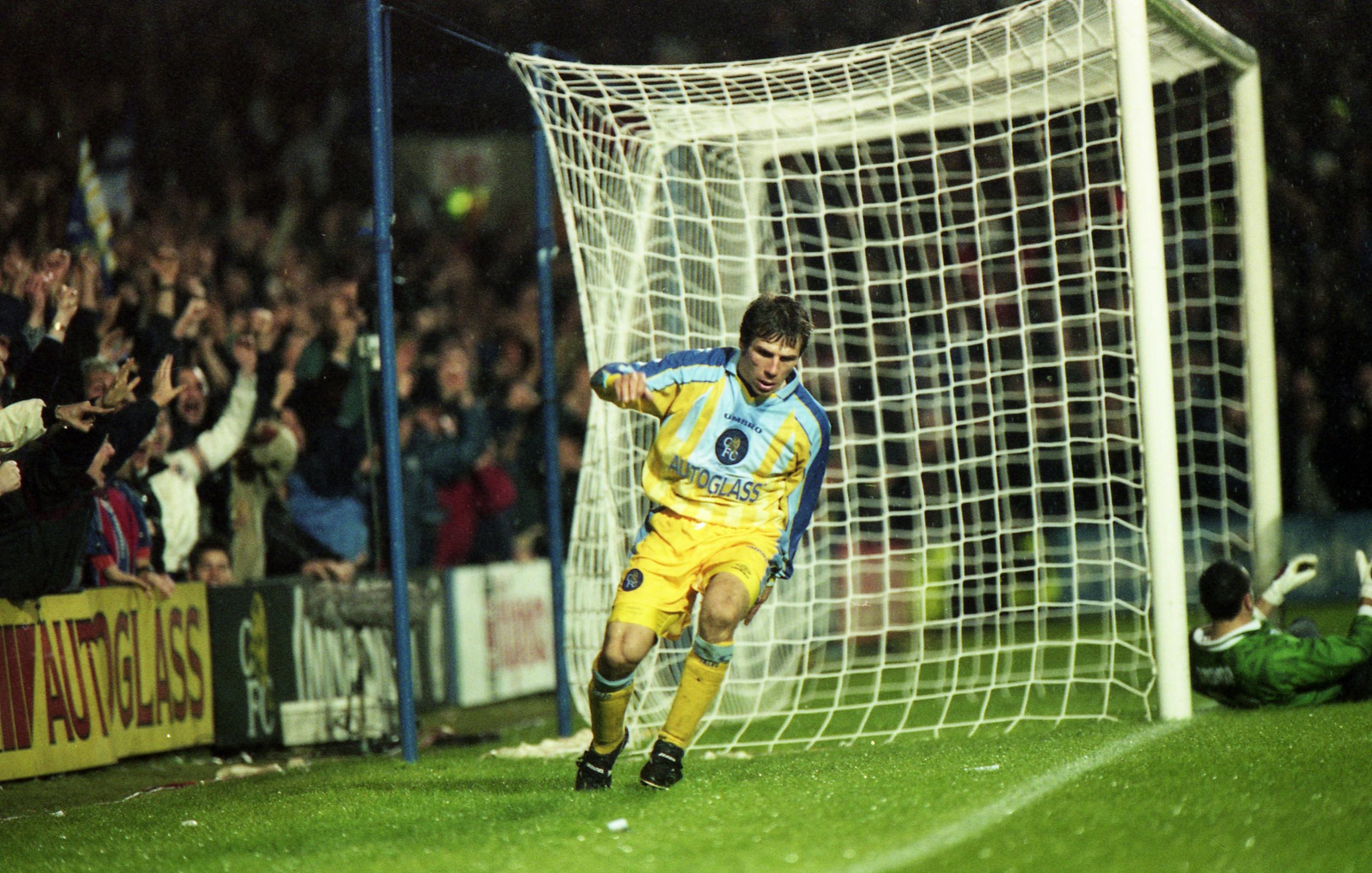
Gianfranco Zola wheels away after scoring one of the great headed Chelsea goals.
‘I wasn’t surprised Franco could reach it at the far post. Whenever we did our pre-season jump tests and power tests, Franco was the one who had the biggest vertical leap, so we always knew he had amazing power, although it did not help that he was smaller than me!’
Chelsea still needed a goal to turn the night from one of exit to one of triumph. Morris was part of a double substitution with 20 minutes left to play, with one of the players brought on Mark Hughes.
‘I was a little gutted to be subbed, because when you think you are doing alright in a game, you never want to be subbed but when a substitute does what Sparky did to take us through, you go “Yeah, fair play!” and I remember the celebrations at the end of the game. As soon as the final whistle went I sprinted onto the pitch and I went straight for Sparky. So a great night at the Bridge and one of those when you really remember the crowd.’
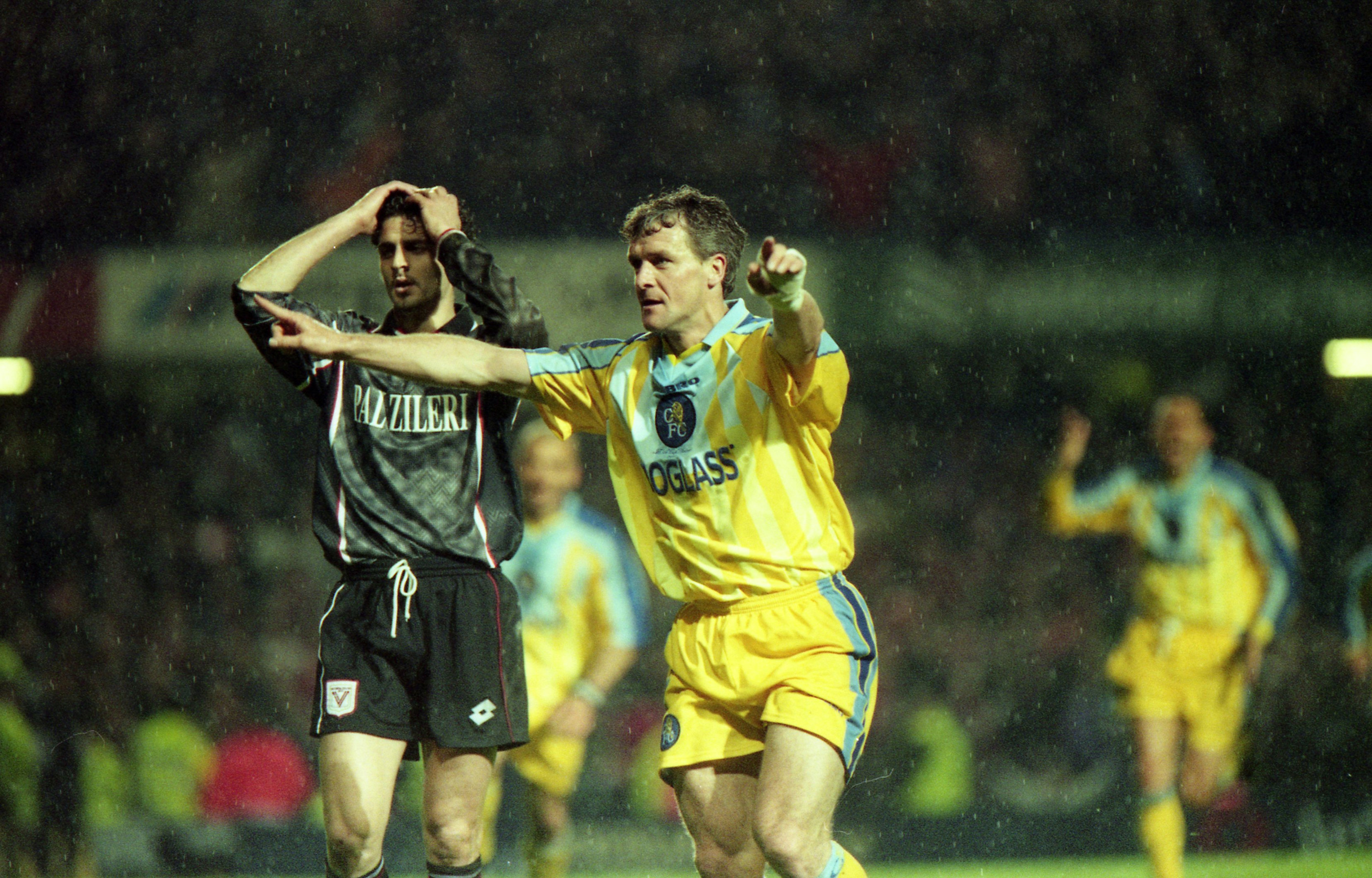
Mark Hughes has just smashed in the winner and taken Chelsea to the final.
Hughes used all of his famed strength and volleying ability to create and finish the deciding goal, a famous winner with quarter-of-an-hour to play, although it still needed a superb late save from Ed de Goey to prevent the result being reversed again.
Vialli’s side went on to win the Cup Winners’ Cup by beating Stuttgart in Stockholm, one of three pieces of silverware collected in 1998.
www.chelseafc.com
On the 22nd anniversary of the famous Cup Winners’ Cup game, we unearth an interview with assistant manager Jody Morris, who remembers what was his full Euro debut and the night Sparky shot Vicenza down…
It was 22 years ago today that Stamford Bridge enjoyed the biggest night on the way to lifting the 1998 UEFA Cup Winners’ Cup.
The competition had reached the semi-final stage, and Chelsea were trailing 1-0 to Vicenza after the first leg in Italy.
But this Blues side had already proved themselves capable of second-leg comebacks, having done just that in the semi-final of the League Cup against Arsenal, thanks to another memorable evening at the Bridge.
We had gone on to win that trophy by the time we played Vicenza, and we had won the FA Cup the previous year to qualify for Europe. This was a Chelsea squad of winners.
To recall the events of the Cup Winners’ Cup second leg against a Serie A side back in 1998, the official Chelsea website spoke to Jody Morris (pictured top left).
It was a massive occasion too for the man who is now assistant to Frank Lampard.
Moses was just 19 years old and the home game against Vicenza was his first start in European competition. Dan Petrescu had been ruled out in the build-up due to illness.
‘Being so young and with it being such a big game, I was proud to be selected and was looking forward it. I remember playing a little bit to the right. Obviously I was not a wide player but there were a few times in my career I played to the side of a four and a bit tucked in.
‘Although it was a tough game, I felt that I was doing alright. I enjoyed the occasion and I enjoyed the atmosphere, the fans were fantastic that night. You could feel it, you could feel the emotion behind the game.’
Although the experienced Petrescu was unavailable, manager Gianluca Vialli was able to field Gustavo Poyet, whose flying start to his Chelsea career had been cruelly halted by a cruciate injury. The prolific midfielder had just one sub appearance to his name since his surgery.
‘It was a boost because Gus was an amazing player for Chelsea when you talk about goalscoring midfielders,’ says Morris. ‘We all know our greatest was Frank [Lampard] but for the period he was at the club and when he was fit, Gus Poyet was a goal machine from midfield.
‘When you get someone like that who was in such great form before, it is good to have them back, and he was a player for the big occasion as well. He had physical presence and a coolness to his play. The side was always better when Gus was in it, I felt.’
The Uruguayan’s return proved vital. Vicenza doubled their lead, grabbing an away goal 32 minutes into the second leg. We needed a rapid response to have any chance and got one three minutes later when a Gianfranco Zola shot was saved but Poyet athletically converted the rebound.
‘That was typical Gus,’ notes Morris. ‘He had a knack for popping up and getting important goals and it gave us belief. For our second goal [scored early in the second half], I remember the cross from Luca for Franco’s header. No one really mentioned it that much because the winning goal got a lot of the plaudits, but if it was someone like David Beckham who had made that cross, it would have been replayed over and over again. And Luca was only out there because he had been arguing with the linesman.
Gianfranco Zola wheels away after scoring one of the great headed Chelsea goals.
‘I wasn’t surprised Franco could reach it at the far post. Whenever we did our pre-season jump tests and power tests, Franco was the one who had the biggest vertical leap, so we always knew he had amazing power, although it did not help that he was smaller than me!’
Chelsea still needed a goal to turn the night from one of exit to one of triumph. Morris was part of a double substitution with 20 minutes left to play, with one of the players brought on Mark Hughes.
‘I was a little gutted to be subbed, because when you think you are doing alright in a game, you never want to be subbed but when a substitute does what Sparky did to take us through, you go “Yeah, fair play!” and I remember the celebrations at the end of the game. As soon as the final whistle went I sprinted onto the pitch and I went straight for Sparky. So a great night at the Bridge and one of those when you really remember the crowd.’
Mark Hughes has just smashed in the winner and taken Chelsea to the final.
Hughes used all of his famed strength and volleying ability to create and finish the deciding goal, a famous winner with quarter-of-an-hour to play, although it still needed a superb late save from Ed de Goey to prevent the result being reversed again.
Vialli’s side went on to win the Cup Winners’ Cup by beating Stuttgart in Stockholm, one of three pieces of silverware collected in 1998.


The eventful life and times of Petar Borota

World Soccer
Originally published.24 February 2013
At a time when football has arguably never been such an unfair competition, it is good to recall an essential part of what makes it special to us regardless of the trophies, leagues and clubs: individual stories.
Tales of unique characters whose existence we know of exclusively thanks to football’s universal language and who play a decisive part in our personal development.
Sometimes, these football characters even go on to become testaments of a particular society, in a particular region, during a particular era.
Petar Borota was one of those characters you would either find in a Monty Python movie, or on a football pitch. Born in Belgrade on March 5th 1952 in the freshly created, carefree Socialist Federal Republic of Yugoslavia.
Borota went on to become a “hero of his time”, to quote Lermontov’s work, embodying the positives and negatives of his era to the delight of football fans all over Europe.
Just as Yugoslavian society in its early days was a unique social experiment, secluded from both Western and Eastern Europe and looking for its own path, Borota was a unique character who would always favour the spectacular over the conventional at a time when that was still accepted in football.
Borota started his career in one of Belgrade’s lesser known suburban clubs, OFK (which later went on to produce another Chelsea great in Branislav Ivanovic), in 1970-1971, coincidentally the year the Stamford Bridge side win their first major European trophy, the UEFA Cup Winners’ Cup prevailing against Real Madrid in the final.
Barely aged 19, he quickly established himself as one of the most solid keepers in the Yugoslavian league, helping lowly OFK break the big four oligopoly (Red Star, Partizan, Dinamo and Hajduk) on three separate occasions between 1969 and 1975.
In parallel to his performances on the pitch (despite a nascent and lifelong habit of throwing the ball on the crossbar before making a clearance), he became renowned for his erratic outings in the capital, driving around in his trademark Citroen CX whose registration plate was already expired when he bought it.
Pledging never to take the same route twice to the OFK training ground, he once joined his team-mates an hour and a half late, exhausted and escorted by two police cars who had chased him on the highway.
He made a total of 176 solid appearances for OFK before moving to Partizan Belgrade in 1975-1976, helping the club win a league of eighteen clubs after conceding only 19 goals, nine in the autumn and ten during spring, with a record-breaking 54 points (a win being only awarded two points at the time).
During a pre-season friendly in France against Nancy in 1977, Borota lined up his wall to defend a dangerous free-kick from up-and-coming youngster Michel Platini.
He cautiously picked four men, only for Platini to lodge the ball into the top corner where the Partizan keeper is stood, having not even made a move, only left to warn his astonished defenders that “this small kid looks a player”.
Twenty minutes later, another free-kick is awarded to Nancy. This time Borota picks five men, only for the French wizard to kick the ball into the other top corner.
The Partizan keeper gets up to his feet and applauds furiously, adding; “I bloody told you this kid was a player!”
Plying a trade of perilous solo runs into the opposition half, Borota alternated hot and cold and on one snowy night in 1978, during an infamous derby between Red Star and Partizan, Miloš Šestić convinced him that the referee had blown his whistle for a foul only for the keeper to drop the ball just in front of the Red Star poacher, who proceeded to tuck it home.
The year before, he had received his first call-up for the Yugoslavian national team in a game against Romania in Bucharest, but conceded a goal after only one minute from a 40-yard free-kick.
Nonplussed, and well aware that nothing makes defenders panic more than an erratic goalkeeper behind them, he uttered the now famous words ; “All under control, folks”. Yugoslavia would go on to win the contest 6-4, but Borota’s reputation never quite recovered and he collected only three further caps for his country.
Odd moments on the pitch and off it too. On one occasion, as he goes to visit injured team-mate Zoran Dimitrijevic at a Belgrade hospital in late 1978 Borata mistakes the entrance of the emergency department for that of the psychiatric clinic, and he is quickly surrounded by dozens of inpatients.
Looking for his way out, he is stopped by a guard with whom he argues that he is not a patient but Petar Borota, the Partizan goalkeeper. Visibly unimpressed, the guard tells him off in no uncertain terms; “Sure… Every other guy here claims to be Dragan Džajić.”
In March 1979, Borota signed for Chelsea as a replacement for the legendary Peter Bonetti for a fee of £70,000.
His antics quickly earn him the praise of the Shed End supporters, whom he always joins in celebrating his team’s goals.
He also runs the show between the goalposts, earning the Player of the Year accolade in 1980 and 1981 after keeping 18 clean sheets in 22 games.
A cult hero, he is met by a fan outside Stamford Bridge asking for an autograph on his right hand.
The next week he meets the fan again, his signature having been turned into a tattoo.
Geoff Hurst appoints him club captain but his increasingly unpredictable behaviour gets the better of him, such as against West Ham in 1982.
With the Blues enjoying a comfortable lead and dominating the game, he sits in his box and opens the match programme.
Frank Lampard Sr. sees it and unleashes a furious shot from distance, forcing the Chelsea captain to spring to his feet and produce a world-class save.
The goal was saved on this occasion but his reputation is becoming increasingly tarnished, especially with Chelsea languishing mid-table and not looking likely to make its way back to the First Division.
Borota is offloaded to Brentford in 1982 before moving to Portugal, first at Portimonense, then to Boavista and finally to Porto where he is condemned to the bench.
He calls a day on his career in 1986, aged 34, eventually moving back to Belgrade where he becomes embroiled in several controversial affairs, culminating in his involvement in an art theft ring which sends him to prison for six months.
Through his Italian acquaintances Sinisa Mihajlovic and Vujadin Boskov, he settled in Genoa where he devoted his time to his other passion, abstract painting, before passing away in the Italian port city on February 12, 2010 after a long illness, aged 56.
By Igor Mladenovic
This article originally appeared in In Bed with Maradona

The Rising Sun
An Untouchable
- Messages
- 9,231
- Reaction score
- 8,247
I was talking with some old Chelsea mates about our Cup win v Leeds at Old Trafford Everyone remembers Ossies brilliant header, but one of the guys pointed out that the sublime pass from Cookie was equally brilliant
Two Chelsea Legends
The Rising Sun
An Untouchable
- Messages
- 9,231
- Reaction score
- 8,247
I remember one newspaper describing him as " the swarthy" Borota!The eventful life and times of Petar Borota
World Soccer
Originally published.24 February 2013
At a time when football has arguably never been such an unfair competition, it is good to recall an essential part of what makes it special to us regardless of the trophies, leagues and clubs: individual stories.
Tales of unique characters whose existence we know of exclusively thanks to football’s universal language and who play a decisive part in our personal development.
Sometimes, these football characters even go on to become testaments of a particular society, in a particular region, during a particular era.
Petar Borota was one of those characters you would either find in a Monty Python movie, or on a football pitch. Born in Belgrade on March 5th 1952 in the freshly created, carefree Socialist Federal Republic of Yugoslavia.
Borota went on to become a “hero of his time”, to quote Lermontov’s work, embodying the positives and negatives of his era to the delight of football fans all over Europe.
Just as Yugoslavian society in its early days was a unique social experiment, secluded from both Western and Eastern Europe and looking for its own path, Borota was a unique character who would always favour the spectacular over the conventional at a time when that was still accepted in football.
Borota started his career in one of Belgrade’s lesser known suburban clubs, OFK (which later went on to produce another Chelsea great in Branislav Ivanovic), in 1970-1971, coincidentally the year the Stamford Bridge side win their first major European trophy, the UEFA Cup Winners’ Cup prevailing against Real Madrid in the final.
Barely aged 19, he quickly established himself as one of the most solid keepers in the Yugoslavian league, helping lowly OFK break the big four oligopoly (Red Star, Partizan, Dinamo and Hajduk) on three separate occasions between 1969 and 1975.
In parallel to his performances on the pitch (despite a nascent and lifelong habit of throwing the ball on the crossbar before making a clearance), he became renowned for his erratic outings in the capital, driving around in his trademark Citroen CX whose registration plate was already expired when he bought it.
Pledging never to take the same route twice to the OFK training ground, he once joined his team-mates an hour and a half late, exhausted and escorted by two police cars who had chased him on the highway.
He made a total of 176 solid appearances for OFK before moving to Partizan Belgrade in 1975-1976, helping the club win a league of eighteen clubs after conceding only 19 goals, nine in the autumn and ten during spring, with a record-breaking 54 points (a win being only awarded two points at the time).
During a pre-season friendly in France against Nancy in 1977, Borota lined up his wall to defend a dangerous free-kick from up-and-coming youngster Michel Platini.
He cautiously picked four men, only for Platini to lodge the ball into the top corner where the Partizan keeper is stood, having not even made a move, only left to warn his astonished defenders that “this small kid looks a player”.
Twenty minutes later, another free-kick is awarded to Nancy. This time Borota picks five men, only for the French wizard to kick the ball into the other top corner.
The Partizan keeper gets up to his feet and applauds furiously, adding; “I bloody told you this kid was a player!”
Plying a trade of perilous solo runs into the opposition half, Borota alternated hot and cold and on one snowy night in 1978, during an infamous derby between Red Star and Partizan, Miloš Šestić convinced him that the referee had blown his whistle for a foul only for the keeper to drop the ball just in front of the Red Star poacher, who proceeded to tuck it home.
The year before, he had received his first call-up for the Yugoslavian national team in a game against Romania in Bucharest, but conceded a goal after only one minute from a 40-yard free-kick.
Nonplussed, and well aware that nothing makes defenders panic more than an erratic goalkeeper behind them, he uttered the now famous words ; “All under control, folks”. Yugoslavia would go on to win the contest 6-4, but Borota’s reputation never quite recovered and he collected only three further caps for his country.
Odd moments on the pitch and off it too. On one occasion, as he goes to visit injured team-mate Zoran Dimitrijevic at a Belgrade hospital in late 1978 Borata mistakes the entrance of the emergency department for that of the psychiatric clinic, and he is quickly surrounded by dozens of inpatients.
Looking for his way out, he is stopped by a guard with whom he argues that he is not a patient but Petar Borota, the Partizan goalkeeper. Visibly unimpressed, the guard tells him off in no uncertain terms; “Sure… Every other guy here claims to be Dragan Džajić.”
In March 1979, Borota signed for Chelsea as a replacement for the legendary Peter Bonetti for a fee of £70,000.
His antics quickly earn him the praise of the Shed End supporters, whom he always joins in celebrating his team’s goals.
He also runs the show between the goalposts, earning the Player of the Year accolade in 1980 and 1981 after keeping 18 clean sheets in 22 games.
A cult hero, he is met by a fan outside Stamford Bridge asking for an autograph on his right hand.
The next week he meets the fan again, his signature having been turned into a tattoo.
Geoff Hurst appoints him club captain but his increasingly unpredictable behaviour gets the better of him, such as against West Ham in 1982.
With the Blues enjoying a comfortable lead and dominating the game, he sits in his box and opens the match programme.
Frank Lampard Sr. sees it and unleashes a furious shot from distance, forcing the Chelsea captain to spring to his feet and produce a world-class save.
The goal was saved on this occasion but his reputation is becoming increasingly tarnished, especially with Chelsea languishing mid-table and not looking likely to make its way back to the First Division.
Borota is offloaded to Brentford in 1982 before moving to Portugal, first at Portimonense, then to Boavista and finally to Porto where he is condemned to the bench.
He calls a day on his career in 1986, aged 34, eventually moving back to Belgrade where he becomes embroiled in several controversial affairs, culminating in his involvement in an art theft ring which sends him to prison for six months.
Through his Italian acquaintances Sinisa Mihajlovic and Vujadin Boskov, he settled in Genoa where he devoted his time to his other passion, abstract painting, before passing away in the Italian port city on February 12, 2010 after a long illness, aged 56.
By Igor Mladenovic
This article originally appeared in In Bed with Maradona
The Rising Sun
An Untouchable
- Messages
- 9,231
- Reaction score
- 8,247
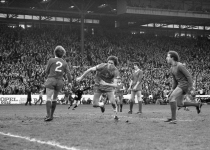
Looks like the game is being played in the street.!!
I think that's the left turning off Billings Street in the background
The Rising Sun
An Untouchable
- Messages
- 9,231
- Reaction score
- 8,247
We had booked flights and hotel in Stockholm before this 2nd leg. Got loads of mockery when we went a goal down and 2 down overall .From April 2020.
www.chelseafc.com
On the 22nd anniversary of the famous Cup Winners’ Cup game, we unearth an interview with assistant manager Jody Morris, who remembers what was his full Euro debut and the night Sparky shot Vicenza down…
It was 22 years ago today that Stamford Bridge enjoyed the biggest night on the way to lifting the 1998 UEFA Cup Winners’ Cup.
The competition had reached the semi-final stage, and Chelsea were trailing 1-0 to Vicenza after the first leg in Italy.
But this Blues side had already proved themselves capable of second-leg comebacks, having done just that in the semi-final of the League Cup against Arsenal, thanks to another memorable evening at the Bridge.
We had gone on to win that trophy by the time we played Vicenza, and we had won the FA Cup the previous year to qualify for Europe. This was a Chelsea squad of winners.
To recall the events of the Cup Winners’ Cup second leg against a Serie A side back in 1998, the official Chelsea website spoke to Jody Morris (pictured top left).
It was a massive occasion too for the man who is now assistant to Frank Lampard.
Moses was just 19 years old and the home game against Vicenza was his first start in European competition. Dan Petrescu had been ruled out in the build-up due to illness.
‘Being so young and with it being such a big game, I was proud to be selected and was looking forward it. I remember playing a little bit to the right. Obviously I was not a wide player but there were a few times in my career I played to the side of a four and a bit tucked in.
‘Although it was a tough game, I felt that I was doing alright. I enjoyed the occasion and I enjoyed the atmosphere, the fans were fantastic that night. You could feel it, you could feel the emotion behind the game.’
Although the experienced Petrescu was unavailable, manager Gianluca Vialli was able to field Gustavo Poyet, whose flying start to his Chelsea career had been cruelly halted by a cruciate injury. The prolific midfielder had just one sub appearance to his name since his surgery.
‘It was a boost because Gus was an amazing player for Chelsea when you talk about goalscoring midfielders,’ says Morris. ‘We all know our greatest was Frank [Lampard] but for the period he was at the club and when he was fit, Gus Poyet was a goal machine from midfield.
‘When you get someone like that who was in such great form before, it is good to have them back, and he was a player for the big occasion as well. He had physical presence and a coolness to his play. The side was always better when Gus was in it, I felt.’
The Uruguayan’s return proved vital. Vicenza doubled their lead, grabbing an away goal 32 minutes into the second leg. We needed a rapid response to have any chance and got one three minutes later when a Gianfranco Zola shot was saved but Poyet athletically converted the rebound.
‘That was typical Gus,’ notes Morris. ‘He had a knack for popping up and getting important goals and it gave us belief. For our second goal [scored early in the second half], I remember the cross from Luca for Franco’s header. No one really mentioned it that much because the winning goal got a lot of the plaudits, but if it was someone like David Beckham who had made that cross, it would have been replayed over and over again. And Luca was only out there because he had been arguing with the linesman.
Gianfranco Zola wheels away after scoring one of the great headed Chelsea goals.
‘I wasn’t surprised Franco could reach it at the far post. Whenever we did our pre-season jump tests and power tests, Franco was the one who had the biggest vertical leap, so we always knew he had amazing power, although it did not help that he was smaller than me!’
Chelsea still needed a goal to turn the night from one of exit to one of triumph. Morris was part of a double substitution with 20 minutes left to play, with one of the players brought on Mark Hughes.
‘I was a little gutted to be subbed, because when you think you are doing alright in a game, you never want to be subbed but when a substitute does what Sparky did to take us through, you go “Yeah, fair play!” and I remember the celebrations at the end of the game. As soon as the final whistle went I sprinted onto the pitch and I went straight for Sparky. So a great night at the Bridge and one of those when you really remember the crowd.’
Mark Hughes has just smashed in the winner and taken Chelsea to the final.
Hughes used all of his famed strength and volleying ability to create and finish the deciding goal, a famous winner with quarter-of-an-hour to play, although it still needed a superb late save from Ed de Goey to prevent the result being reversed again.
Vialli’s side went on to win the Cup Winners’ Cup by beating Stuttgart in Stockholm, one of three pieces of silverware collected in 1998.
Thought we'd wasted our money, but NO !!


Boyne
We Are The People
- Messages
- 30,024
- Reaction score
- 35,047
The goals from that Vicenza Semi Final Second Leg in April 1998.
I was in the MHU for that game and had great views of the goals from Zola and Hughes. I can't remember seeing Zola score many goals from a header but he put a lot of power into the header. Great cross from Luca. As for Sparky's goal I remember thinking at the time that after he flicked the ball forward he was going to volley it and he did.
The atmosphere that night was brilliant.